
Photo Credit: ACI AFrica
By Chioma Polok
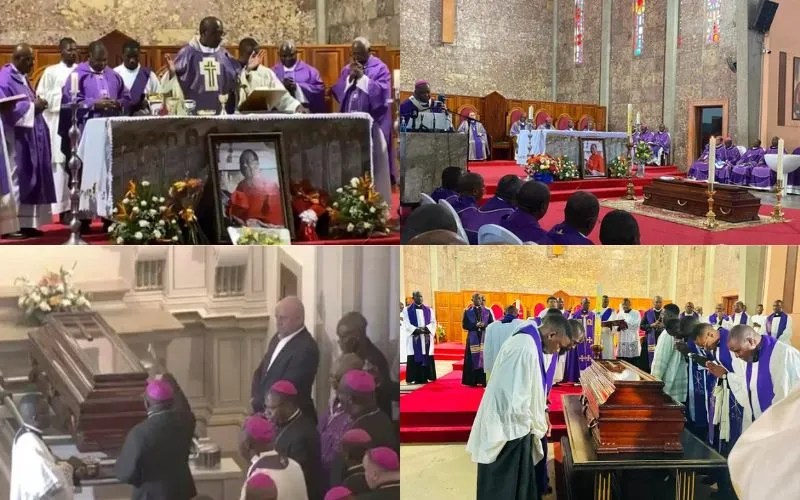
Alexandre Cardinal do Nascimento, Angola’s first and the world’s oldest Cardinal, passed away on September 28 at the age of 99. He was laid to rest on Tuesday, October 8, inside the Cathedral of Our Lady of the Immaculate Conception, Luanda, following a funeral Mass at Holy Family Parish. Cardinal do Nascimento will be remembered as a man firm in his Christian faith and unwavering in his service to God and humanity.
Born in Malanje, Angola, on March 1, 1925, Cardinal do Nascimento was ordained a priest in December 1952. After his Episcopal consecration, he served as the Local Ordinary of the Diocese of Malanje before being appointed Archbishop of Lubango in February 1977. He was elevated to the rank of Cardinal in the February 1983 consistory. In February 1986, he was transferred to the Archdiocese of Luanda, where he served until his retirement.
ACI Africa revealed that during the funeral Mass, Archbishop Zeferino Zeca Martins of Huambo recounted the Cardinal’s legacy, describing him as a man who held “a high vision of human dignity” and as “a man of strong faith and unquestionable loyalty, captivated by Jesus Christ.” The Archbishop praised the Cardinal’s dedication to his ministry as a Christian, priest, pastor, and Cardinal, noting that his spirituality was deep and rooted, allowing him to approach life with hope and joy, trusting in God’s will.
Despite his advanced age, the late Cardinal remained a symbol of joy and concern for others, always offering a smile and asking, “How are you, my son?” or “How are you, my daughter?” Archbishop Zeca reflected on the Cardinal’s enduring strength, saying, “His Episcopal motto, ‘The name of the Lord is a mighty tower,’ characterized him throughout his life. Nothing could make him falter, not even the challenges of his people, his country, or his Church.”
The Archbishop emphasized that the late Cardinal’s life should inspire reflection, saying, “This Mass in his presence should prompt us to reflect on the legacy of this son of the Church and of Angola, in our lives, in our Christian communities, and in the future of our country.”
He further remarked, “Cardinal do Nascimento, who now leaves us, was rooted in sincere love and dignified respect. He was committed to the common good and confident in the happiness of all Angolans and humanity as a whole.”
During the funeral, Archbishop Zeca reminded the congregation that building a better Angola is a shared task, saying, “Building true peace and reconciliation is a commitment we must make before this Prince of the Church, whom we now bury at the feet of Mary in the Cathedral of Luanda.”
In his homily, the Archbishop called on the faithful to reflect on their own commitment to living the authenticity of the Christian faith, acknowledging the Cardinal’s blend of devotion and patriotism. He said, “Among the loves of His Eminence, we often heard him say: ‘Love Our Lord Jesus Christ, love the Virgin Mary, love Angola, love your homeland. Respect the dignity of all men.’”
The late Cardinal’s devotion to spiritual discipline was also highlighted, with Archbishop Zeca noting, “Deeply in love with Christ, Dom Alexandre embodied disciplined discipleship, displaying rigorous devotion to God and his brothers.”
The Cardinal’s leadership extended beyond Angola, as he once served as president of Caritas Internationalis, a role in which he advocated for the poor and suffering during the nation’s colonial period and civil war.
In their tribute, members of the Bishops’ Conference of Angola and São Tomé and Príncipe (CEAST) described the late Cardinal as a man who devoted himself to the cause of God. “He lived through the vicissitudes of the civil war and Marxism-Leninism,” they said. Though he fell short of celebrating his 100th birthday, CEAST members remarked, “Next year, we will celebrate his jubilee, but he will be with us in spirit, celebrating in the heights.”
The CEAST members concluded with a powerful reminder of the Cardinal’s teachings: “He taught us to love Angola, to seek justice, and that a seminarian or priest who does not pray is a monster. We remain vigilant in his memory.”

 TWE Media Network
Leave a comment