
Photo credit: KT Press
By TWE Newsdesk
In a historic political comeback, former President Donald Trump has won a second, nonconsecutive term, defeating Democratic candidate Vice President Kamala Harris in a fiercely contested election. Trump’s victory makes him the first U.S. president in nearly 130 years to achieve this feat, adding a remarkable chapter to his political legacy.
As of Wednesday morning 6 November, major news networks, including Fox News, had confirmed Trump’s win, with the final Electoral College count showing 276 votes for Trump to Harris’s 219, alongside a popular vote lead of 5 million. Trump’s success can largely be attributed to significant support among Catholic voters, both nationally and in key swing states, a demographic that played a pivotal role in his victory.
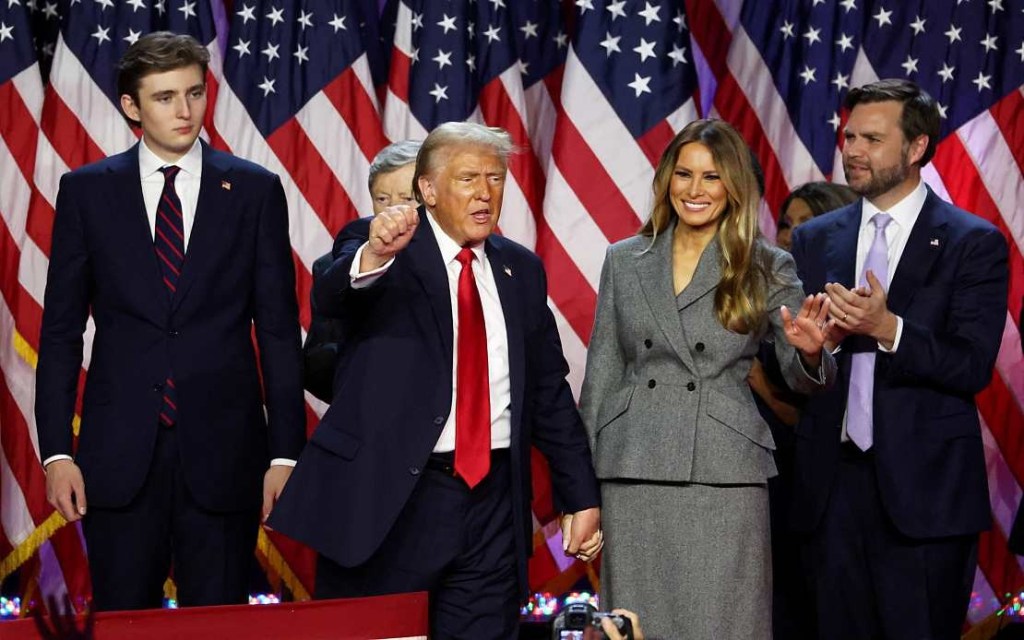
Trump addressed his supporters early Wednesday from the Palm Beach Convention Center in Florida, celebrating his win as “the greatest political movement of all time.” “Every citizen, I will fight for you, for your family, and your future,” he declared. “With every breath in my body, I will not rest until we have delivered the strong, safe, and prosperous America that our children deserve.”
In a report by Catholic News Agency, Trump’s path back to the White House was marked by a determined four-year campaign, during which he overcame numerous legal challenges, including a high-profile felony conviction. His coalition was bolstered by support from prominent figures like Elon Musk, Robert F. Kennedy Jr., Buzz Aldrin, and Peter Thiel. A key aspect of his campaign was his outreach to Catholic voters, whom he framed as a crucial constituency in the battle against what he called Harris’s “destructive” policies toward the Catholic Church.
Exit polls revealed a significant shift in the Catholic vote, which had played a decisive role in Trump’s victory. According to the Washington Post, Trump won the Catholic vote nationally by a 15-point margin (56% to 41%), a dramatic increase from his five-point lead over President Joe Biden in 2020. Trump also performed strongly among voters opposed to abortion, securing 90% of those who favored abortion restrictions. Conversely, Harris won 69% of Catholic voters who believed abortion should be legal in most cases.
The Associated Press VoteCast poll showed a slightly narrower lead for Trump among Catholics, with the former president garnering 52% compared to Harris’s 45%. This poll also revealed that while Harris was trusted more by 46% of Catholics on abortion policy, Trump enjoyed stronger support on economic and immigration issues, with a 19-point lead on the economy (55% to 36%) and a 25-point lead on immigration (57% to 32%).
CNA reports that in key swing states, Catholic voters again favored Trump. According to NBC News, Trump won 56% of the Catholic vote in 10 swing states, compared to Harris’s 41%. His support was even stronger among white Catholic voters, with 60% backing Trump and 37% supporting Harris. States included in the poll were Arizona, Florida, Georgia, Michigan, Nevada, North Carolina, Ohio, Pennsylvania, Texas, and Wisconsin. In these states, Catholics accounted for 22% of the electorate, with 15% identifying as white Catholics.
Throughout his campaign, Trump and his running mate, Ohio Senator JD Vance, worked tirelessly to court Catholic voters. Trump, in particular, criticized Harris for missing the annual Al Smith dinner and labeled her “destructive to Christianity.” Vance, a practicing Catholic, also accused Harris of “anti-Catholic bias” in an op-ed and emphasized that many Catholic voters felt abandoned by the current administration.
In addition to his efforts to win the Catholic vote, Trump reaffirmed his commitment to religious liberty, a central pillar of his platform. During an October interview with The World Over’s Raymond Arroyo, Trump reiterated that protecting religious freedom would be a priority for his second term. His campaign launched the “Catholics for Trump” coalition, which focused on religious liberty, traditional values, and the sanctity of life.
As Trump prepares to assume office again, his administration will work to fulfill the promises made during his campaign, which he outlined as a “new level of importance” for his vision of a strong, prosperous, and united America.

 TWE Media Network
Leave a comment