
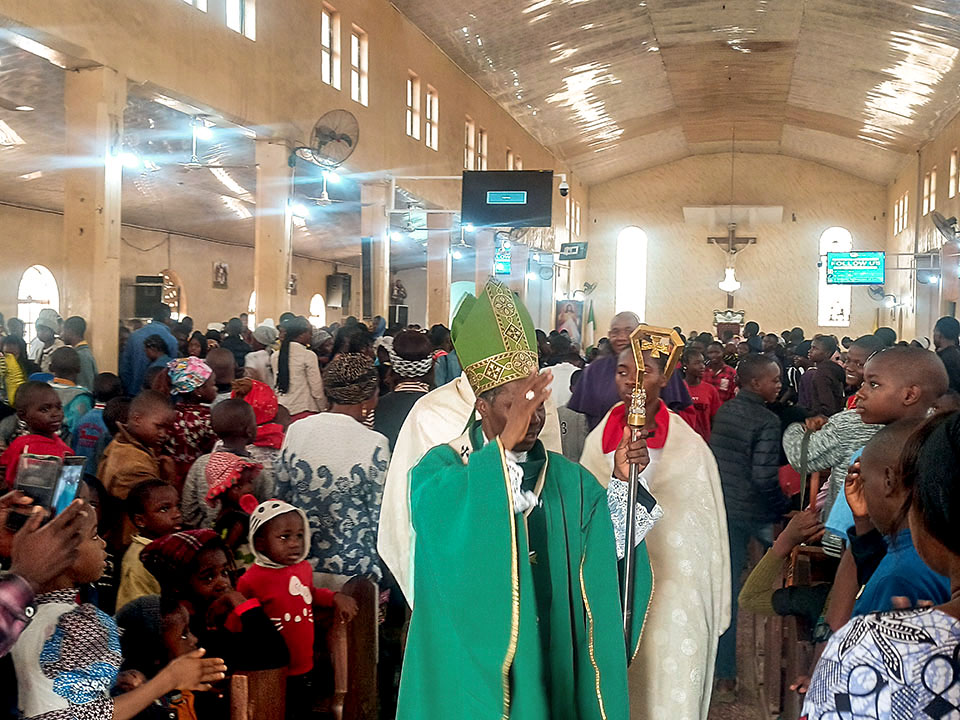
By Juliana Uzoka
The Catholic Archbishop of Jos, Most Rev. Ishaya Matthew Audu, has urged the faithful to deepen their prayer life and ensure it reflects true honour to God.
Delivering his homily during the Mission Sunday celebration, Archbishop Audu outlined key principles for an effective prayer life, emphasizing faith, right intention, perseverance, humility, and patience.
He said faith remains the most potent factor in prayer, lamenting that many Christians tend to dictate to God how and when their prayers should be answered. “Some even threaten to abandon worship when they experience delay,” he observed, warning that such attitudes show a lack of trust in God’s will.
The Archbishop stressed that prayers should align with God’s plan and not merely personal desires. “Praying with the right intention means that what we ask must be for our good, for the good of others, and in accordance with God’s will,” he said.
To illustrate his point, he told the story of a young boy who, during an examination, prayed earnestly saying, “Tokyo, Tokyo, Tokyo,” believing it was the capital of Mexico. The Archbishop used the anecdote to show how people sometimes ask for the wrong things in prayer. “When we pray, are we trying to change God’s mind to suit ours, or are we allowing our minds to conform to God’s will?” he asked.
Quoting the Gospel reading for the day, Archbishop Audu recalled Jesus’ question: “When the Son of Man comes, will He find faith on earth?” He urged Christians to “pray continually and never lose heart,” explaining that perseverance keeps hope alive even when results are not immediate.
He cautioned against trying to “box God into answering prayers exactly how we want,” noting that impatience can make believers miss God’s presence in unexpected ways. “God knows what is best for us. When He does not respond immediately, it may be because our wants are often short-sighted or self-centred,” he said.
Referring to the Catechism of the Catholic Church (CCC 2559), Archbishop Audu reminded the faithful that humility is the foundation of prayer and that every person stands as a beggar before God, needing His guidance.
To demonstrate the transforming power of prayer, he narrated the story of a teacher named Mary whose troublesome student, Bill, later rediscovered a prayer she had written for his conversion. Many years after, reading that same prayer led to his transformation, turning him away from a life of evil.
“Two points are clear,” Archbishop Audu said. “First, prayer has enormous power, and second, perseverance sustains it.” Quoting Nobel Laureate Dr. Alexis Carrel, he affirmed that “prayer is a force as real as gravity.”
The Archbishop also encouraged the faithful to cultivate a structured prayer routine despite their busy schedules, describing prayer as “an intentional action that binds us to God.” He further recommended developing support systems or prayer partners to help maintain consistency.
Concluding his homily, Archbishop Audu challenged the congregation with reflective questions:
“Do you pray with faith? Do you pray with right intentions? Do you persevere in prayer, or do you give God an ultimatum when answers delay? Has the instant culture of Google and AI influenced your spirituality of prayer?”
He ended by reminding the faithful of the essence of Mission Sunday, calling on every Christian to participate actively in spreading the Good News. “Just as Jesus obeyed the will of His Father, we too are called to sustain the mission of Christ throughout the world,” he said.

 TWE Media Network
Leave a comment