
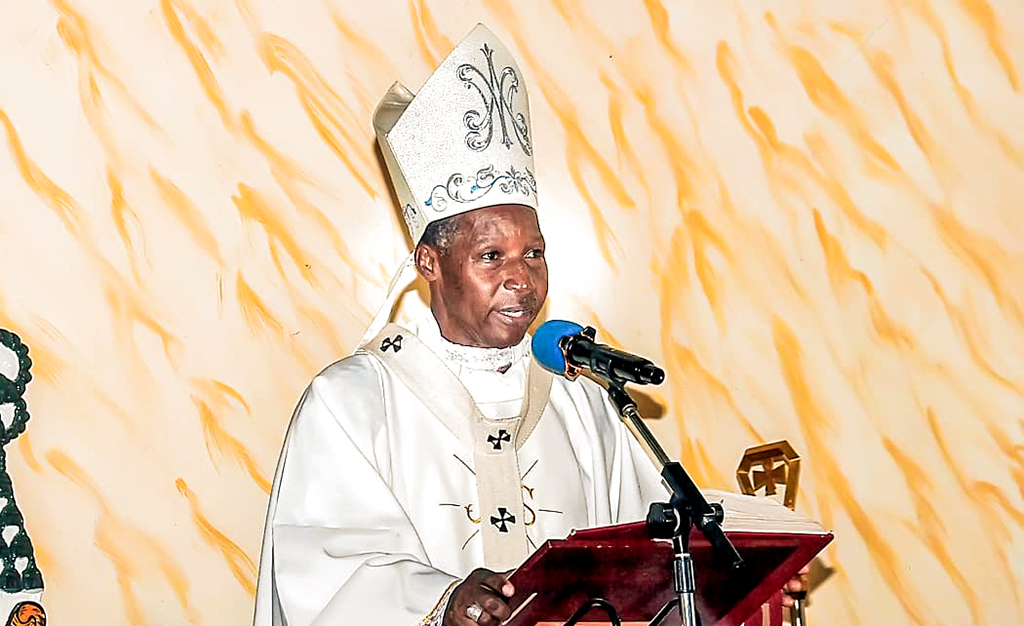
By Juliana Uzoka
The Feast of the Ascension of Jesus Christ is a call to live out Christ’s teachings and evangelize the world through a life devoted to Him, the Catholic Archbishop of Jos, Most Rev. Matthew Ishaya Audu, has said.
In his homily on Thursday during the celebration of the Ascension in the Archdiocese of Jos, Archbishop Audu described the solemnity as one of the most significant feasts in the Catholic Church. He explained that it commemorates Christ’s appearances to His Apostles and disciples after His Resurrection and His Ascension into heaven in their presence.
Celebrated globally on Thursday, and in some Archdioceses on Sunday, June 1 around the world, the Archbishop said the feast remains a reminder that Jesus’ command to “bear witness” to Him by preaching and teaching about the Kingdom of God is as relevant today as it was in the early Church.
Quoting Matthew 28:19–20 “Therefore, go and make disciples of all nations; baptize them in the name of the Father and of the Son and of the Holy Spirit, and teach them to observe all the commands I gave you.” The Archbishop noted that the Great Commission is not limited by time.
He emphasized that although Christ has ascended, He still works in and through humanity, accompanying the faithful in their daily journey.
Illustrating this with a story, Archbishop Audu recounted the experience of a man who, in a vision, saw his life as a timeline marked by footprints in the sand. At joyful moments, he saw two sets of footprints — his and Jesus’. But during the most challenging periods, he noticed only one. Saddened, he asked Jesus why He had abandoned him in those trying times. Jesus replied: “My dear child, I love you so much that I never left you. In your most difficult moments, when you had to suffer the most, and where you see only one pair of footprints, I carried you.”
The Archbishop said this remains the kind of relationship Jesus offers His followers – a loving, abiding presence, even when He is unseen.
Archbishop Audu went on to highlight the supreme power of God revealed in Christ’s Ascension. He compared it to natural disasters such as earthquakes, cyclones, hurricanes, typhoons, tornadoes, and fires — events that cause fear and awe due to their destructive force. Yet, he said, Jesus’ Ascension reveals a higher, divine power — the power of God — made visible through His miracles: healing the sick, calming storms, raising the dead, and finally, ascending into heaven.
“Ascension,” the Archbishop explained, “means Jesus was taken into heaven.” He recalled the amazement of the disciples as they watched Christ being “lifted up while they looked on, and a cloud took Him from their sight.” It was a sight never before seen, a man ascending bodily into the clouds.
He stressed that if Jesus had not ascended to the Father, where the faithful hope to join Him, believers might have doubted the existence of heaven. “The Ascension is proof that Jesus is one with the Father, divine and eternal and that our hope of heaven is real,” he said.
Archbishop Audu emphasized that the significance of the Ascension goes beyond Jesus’ divine identity. It offers a glimpse into the kind of relationship God desires with mankind — one rooted in trust, love, and eternal communion. Jesus’ teachings, miracles, and fulfilled prophecies, the Archbishop said, further validate His divine claims.
Citing the Gospel of John (1:50–51), the Archbishop recalled when Jesus told Nathanael that He saw him under the fig tree, and hinted at something greater: “You will see heaven opened and the angels of God ascending and descending on the Son of Man.”
“Ascension,” he continued, “was necessary to show that Jesus not only leads people closer to God, but leads them to God Himself.”
He affirmed that by ascending, Jesus proved that there is a better place for those who believe in Him and obey His commandments, a place where they will see God face to face.
“The Ascension shows that Jesus lives forever, and so can we, His followers,” Archbishop Audu declared. “The earth is a temporary place. It is transient. Our account of life on earth will become crucial when the time for judgment comes.”
He urged Christians to live exemplary lives that reflect their identity in Christ, saying: “Set your sights directly on God the Father, our Creator. Jesus gives us the perfect example. His entire life was directed toward the Father.”
Referencing a scholar who once challenged Christians to “live like the Christ they profess,” the Archbishop noted that many believers live in contradiction to the God they claim to serve.
While the Ascension may appear to mark Jesus’ departure from the earth, Archbishop Audu said it fulfills Scripture and signals God’s continued redemptive work through the Church. Jesus’ promise to remain with His followers until the end of time, he added, remains unshaken.
He emphasized that Christ’s Ascension affirms His eternal nature and validates the hope of eternal life for believers. “Nothing can contradict this truth, He has shown beyond doubt that He lives,” he said.
Archbishop Audu concluded by challenging the faithful to bear witness to Christ through their way of life, not merely through words. “The most effective form of evangelization,” he said, “is living a true Christian life, in the family, workplace, community, in every space, our life must proclaim Christ.”
He added: “The way to begin preaching Jesus to the world is to begin preaching Jesus to ourselves.”
As the Church prepares for Pentecost, the Archbishop urged all to pray fervently for the outpouring of the Holy Spirit, which Jesus promised would come with divine gifts to strengthen the faithful.
He ended with a charge: “Once we begin to live this way, the message of Jesus will ripple across the world. And if enough Christians do this, that ripple will become a tidal wave that will change the face of the earth in ways we never imagined. This is the message of today’s feast.”

 TWE Media Network
Leave a comment