
By TWE News Desk
The Forum of State Independent Electoral Commissions of Nigeria (FOSIECON) has reaffirmed the constitutional relevance of State Independent Electoral Commissions (SIECs) and rejected calls for their abolition, describing such proposals as “mischievous and anti-federal.”
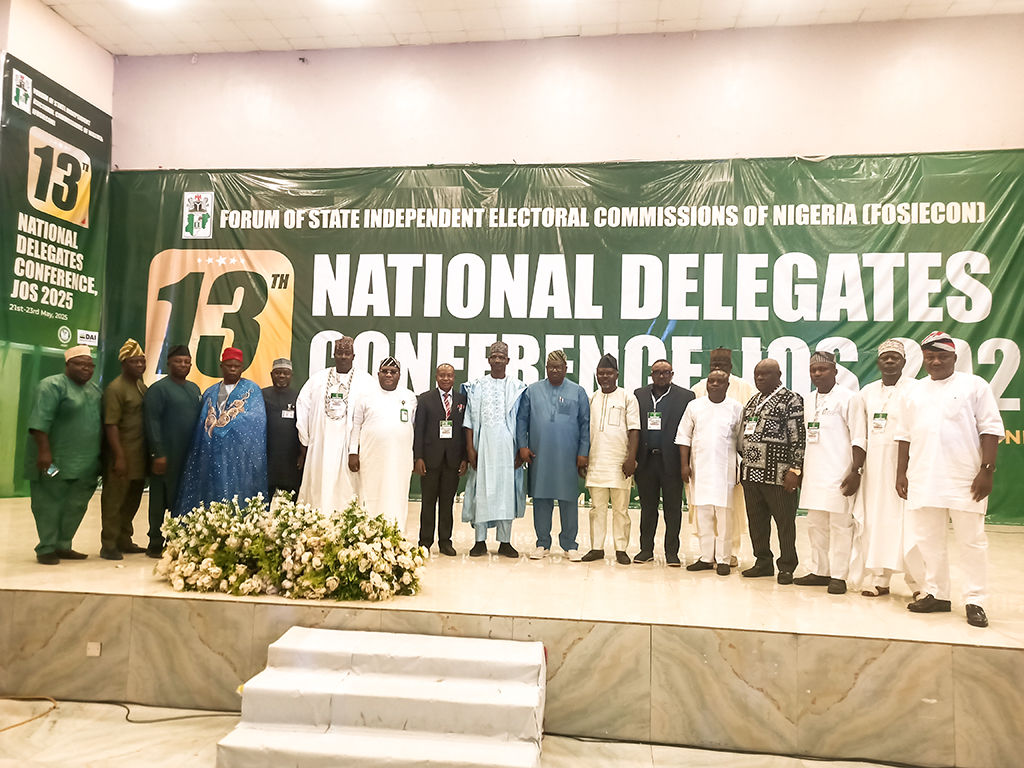
This was contained in a communique issued at the end of the Forum’s 13th National Delegates’ Conference held from May 20 to 23, 2025, in Jos, Plateau State. Themed “Local Government Elections in Nigeria: Issues, Challenges and Opportunities,” the conference brought together delegates from 27 states to deliberate on strategies to enhance the credibility of local government elections and reposition SIECs for optimal performance.
In the communique signed by FOSIECON National Chairman, Chief Barr. Jossy C. Eze, and National Secretary, Assoc. Prof. Joseph I. Aremo, the Forum emphasized that SIECs remain a vital institution in Nigeria’s democratic architecture.
“SIECs have come to stay and any call for its scrapping is mischievous and anti-Federal Constitution of Nigeria,” the communique stated.
The Forum called for urgent legislative and administrative reforms to strengthen SIECs and enable them to discharge their constitutional mandates effectively. Key among the resolutions was a demand for greater independence.
“Administrative independence and financial autonomy of the SIECs should be prioritized as an impetus of strengthening SIECs to deliver on their constitutional mandates,” the statement read.
Delegates also urged state electoral bodies to engage the public more proactively to rebuild trust and credibility.
“Regular public engagements with election stakeholders should be embarked upon across the 768 local government areas to build confidence in the capacity of SIECs to organize and conduct credible and transparent Local Government Polls,” the Forum resolved.
On the role of political parties, the communique called for internal reforms to ensure that only credible candidates emerge for public office.
“Political parties as the only platform for filing nomination of candidates for election should evolve mechanisms for emergence of leadership of proven integrity,” it stated, adding that “the electorate should always review the activities and performance of their representatives for the purpose of accountability.”
The Forum also called for the extension of institutional reforms enjoyed by the Independent National Electoral Commission (INEC) to SIECs.
“Extension of legal and institutional reforms that strengthened INEC’s operation to SIECs is necessary for optimal performance,” it stated.
To ensure uniformity in local elections, the Forum recommended that State Legislatures adopt provisions from the 2022 Electoral Act relating to Area Council elections.
“State Legislatures should take pragmatic steps to adopt the relevant provisions of the Electoral Act 2022 on procedure of conduct of Area Councils Elections to evolve uniformity and certainty in the electoral procedure of Local Government elections,” the communique advised.
The Forum further underscored the role of civic education in enhancing participatory democracy, calling for stronger collaboration with civil society and development partners.
“SIECs should intensify efforts in collaborating with CSOs and development partners to provide capacity building that will enhance voters’ education and civic competence of the grassroots electorate because ‘All Politics is Local’,” the statement read.
The conference, attended by chairmen, secretaries, and members of SIECs from across 27 states, was convened to examine operational challenges and reimagine electoral practices at the grassroots in line with the principles of federalism and democratic accountability.

 TWE Media Network
Leave a comment