
By TWE News Desk
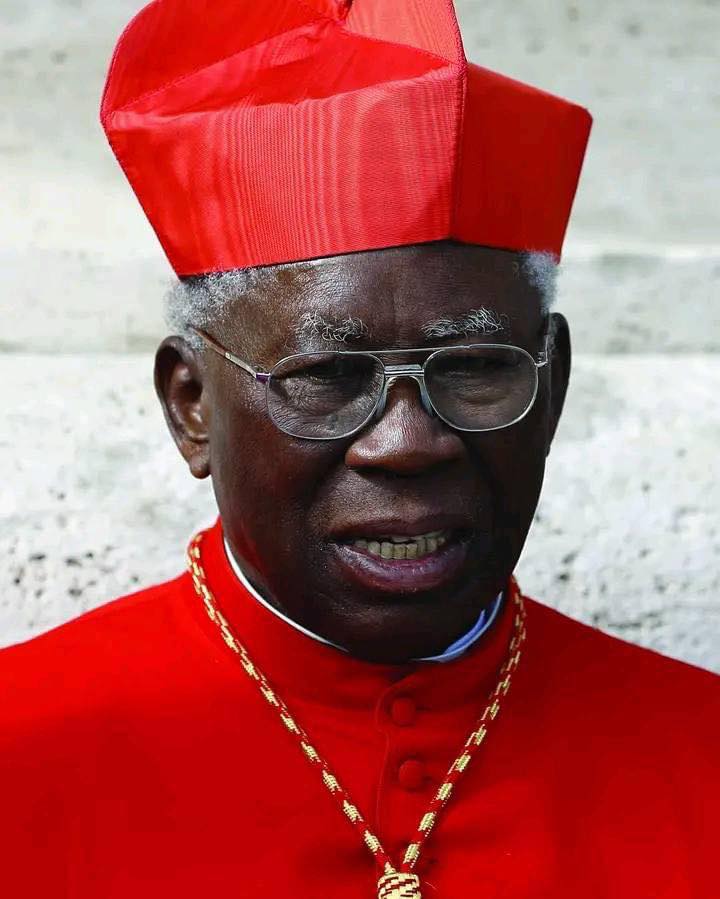
As the Catholic Church looks toward the future leadership of the Holy See, Nigerian Cardinal Francis Arinze, one of the most respected voices among the senior hierarchy, has emphasized the need for a pope who is “full of fire for the kingdom of Christ.”
In a reflective and candid interview with CNA, the 92-year-old cardinal offered stirring advice on what the Church must look for in the next successor of St. Peter. Drawing from his six decades of episcopal ministry and over forty years as a cardinal, Arinze’s insights come at a critical moment as the global Church prepares for a conclave to elect a new pope.
“We want a pope who is full of fire for the kingdom of Christ,” he said. “A pope who is there spreading the Gospel… A pope through whom people will believe.”
For Arinze, the central mission of the Church remains unchanged: evangelization. He described the core challenge of the Church as the need to “convince people to accept Christ and live according to his teaching and example,” noting that this mission, while simple in its call, is difficult in practice. “But that is what the Church is for,” he said.
Cardinal Arinze brings a profound historical perspective to his observations. He was the youngest bishop in the world when he participated in the final session of the Second Vatican Council in the 1960s. Later, he served more than 20 years in the Roman Curia and participated in the 2005 conclave that elected Pope Benedict XVI.
Reflecting on the papacy, Arinze reminded Catholics that no two popes are the same — and that’s by divine design.
“No pope is a photocopy of another pope,” he said. “Pope John Paul II is not the same as Pope Benedict. Pope Benedict is not the same as Pope Francis… They were all different, but all apostles of Christ.”
Arinze commended Pope Francis for his unique pastoral approach, particularly his focus on the poor and the marginalized, saying, “You notice that Holy Father Pope Francis privileges the weak, not so much the strong or the powerful. Every pope has his style.”
Though he is beyond voting age and will not enter the Sistine Chapel, Cardinal Arinze joins the ranks of senior cardinals participating in pre-conclave discussions known as general congregations. To the younger cardinals who will cast their votes, he offered sobering advice:
“Realize that we are in God’s hands,” he said. “And that the Church is not made by me or by the pope but by Christ. If the Church had not been founded by Christ, it would have fallen to pieces long ago.”
Citing Christ’s assurance that he will be with the Church “until the end of time,” Arinze added poignantly: “Even Judas Iscariot could not pull down the Church.”
Yet he warned of the potential harm caused by leaders who stray from their call. “Even if you get a pope who is not a good pope… they cannot pull down the Church. But they can do damage. They can hurt. They can injure. So every one of us has to, in fear and trembling, ask himself: ‘What is God calling me to do in the Church, for the Church, and with the Church?’”
As the conversation turned to personal wisdom gained over a long life, Cardinal Arinze spoke of trust in divine providence.
“God is the director general of history,” he said. “He is also the providence for each individual… We think that we are directing everything, but God is there, who looks into the details.”
Echoing the words of St. Teresa of Calcutta — “May God help us not to spoil his work” — Arinze encouraged believers to remain humble and open to grace.
“If we would be faithful to God … God will do great things for us,” he said. “We just beg God that we do that little part which he expects of us, so that his work will succeed.”
Cardinal Arinze’s enduring voice offers both challenge and consolation — a call to fiery faith and a reminder that in every season of the Church’s life, it is Christ who remains at the center, the cornerstone, and the reason for hope.

 TWE Media Network
Leave a comment