

By Juliana Uzoka
In a world ravaged by hunger and political upheaval, consecrated persons in the Catholic Church have been urged to bring hope to the people by strengthening the local Church through evangelism.
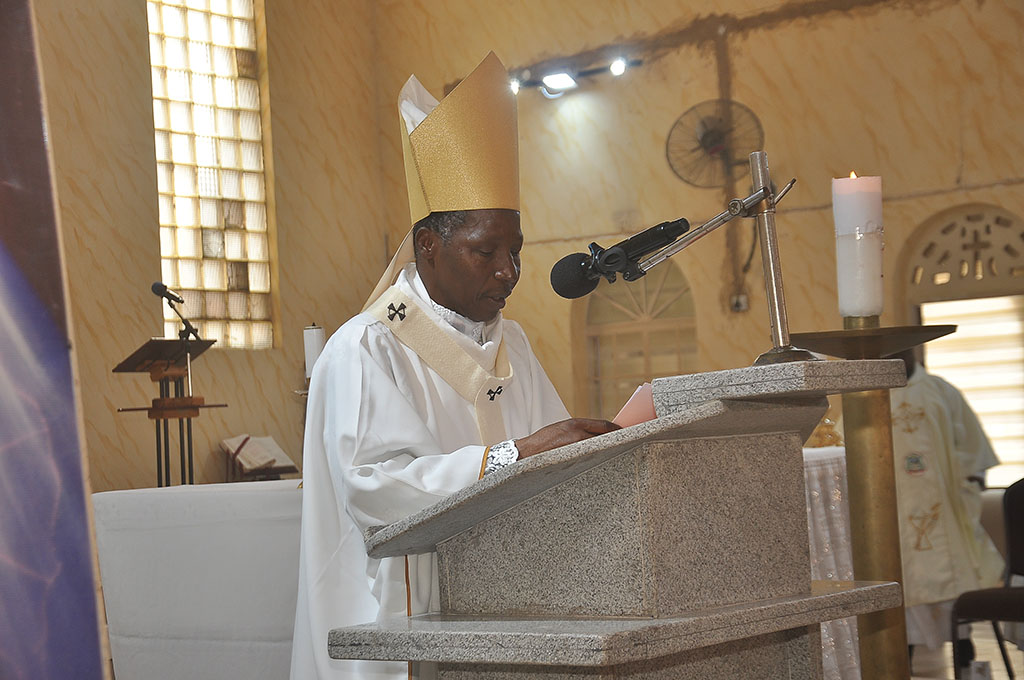
The Catholic Archbishop of Jos Archdiocese, Most Rev. Matthew Ishaya Audu, gave this charge during the celebration of the Feast of the Presentation of Our Lord Jesus Christ, a day when consecrated persons—including priests and religious—renew their commitment and service to Christ and humanity.
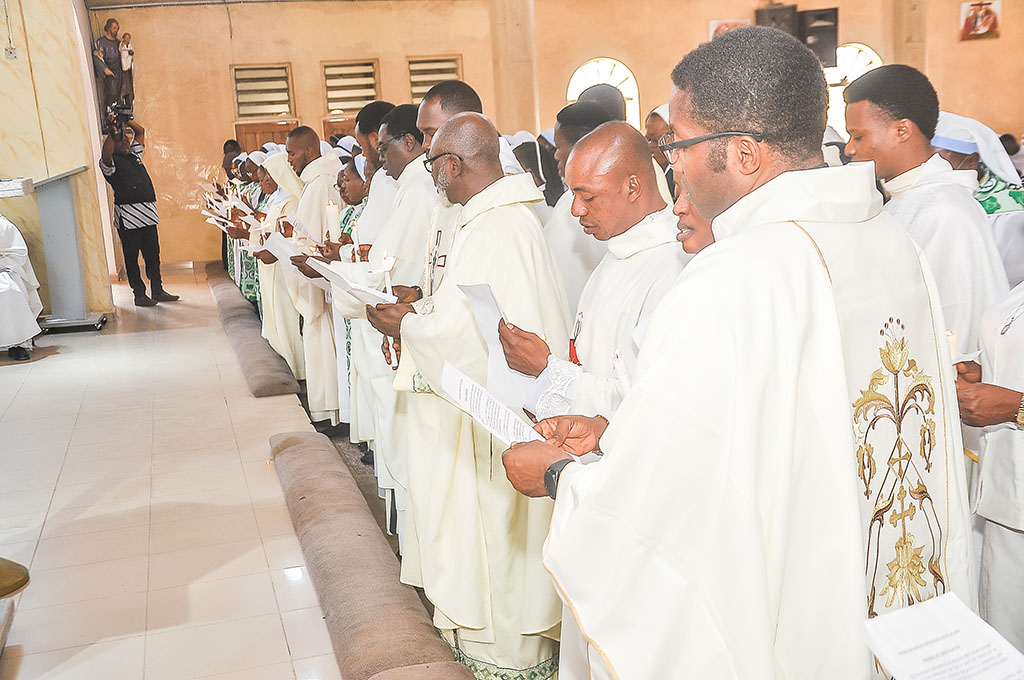
Processing with candlelight, illuminating a world plunged into darkness by sin and strife, they marched with a “long string of expectation,” assured of renewed hope through the sacrifices of poverty, chastity, and obedience to Jesus, our Redeemer, who welcomes the faithful and bequeaths them a life devoid of suffering and full of peace.
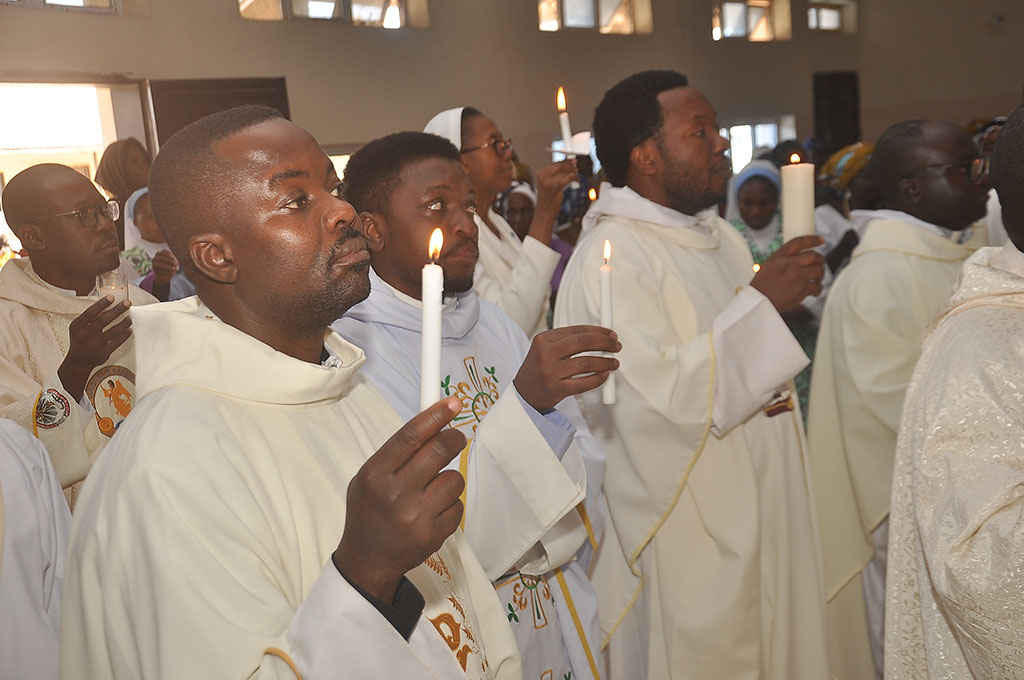
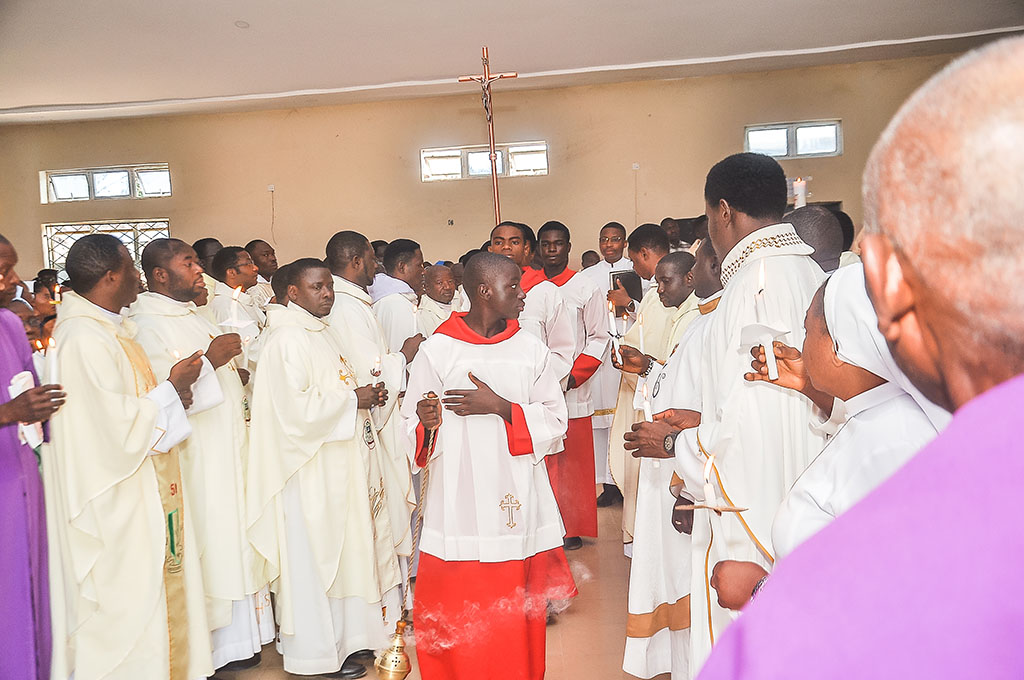
Observed annually on 2 February, the feast was marked on 6 February in the Catholic Church in Jos Archdiocese because it fell on a Sunday, a day of obligation.
The Feast of the Presentation of Our Lord is also called the Purification of the Blessed Virgin Mary, rooted in the Jewish tradition that required women who had given birth to a child—male or female—to observe 40 days of seclusion. Celebrated every 2 February, exactly 40 days after 25 December, it marks the end of the festive season of Christ’s birth.
The origins of the feast are found in the books of Leviticus, Exodus, Numbers, and Deuteronomy, where Jewish law required a gift offering of a lamb, a pigeon, or a turtle dove as a sin offering.
Steeped in rich tradition, Archbishop Audu explained, “Under the Mosaic Law, a woman was declared spiritually unclean for 40 days after giving birth, after which she was to present herself to the priest at the temple and offer sacrifices of purification for her uncleanness, and indeed for her firstborn child.” He further clarified that, in this case, Jesus and Mary were without sin but fulfilled a Jewish requirement with deep significance for humanity.
He noted that while the practice is not observed globally, it is celebrated worldwide in all Catholic churches.
“You have to be torn in order to remain relevant,” the Archbishop told the consecrated persons, highlighting the challenges of evangelism and taking the Word of hope to a people devastated by life’s hardships. In Nigeria, he said, poor leadership has worsened living conditions, with many dying of hunger and poverty-related circumstances.
“In our world today, people hunger for freedom in all sorts of ways, including political and economic freedom. In our country, we face so many challenges and difficulties. Today, many can no longer afford three square meals due to the situation in the country. A lot of people have been displaced from their ancestral homes. Even when they farm, they cannot harvest, and unfortunately, the government is not helping matters,” Archbishop Audu stated.
Nigerians, he said, remain in a state of despair with their “long list of expectations.” He questioned, “What hope lies ahead for the common man?”
“Will Nigerians, like Simeon and Prophetess Anna in the temple, heave a sigh of relief someday when leaders take charge and redeem their electoral promises to the masses who voted them into power?” he further asked.
Intertwining this reflection with faith, the Archbishop assured the faithful, “God never goes back on His words.”
“Simeon and Anna waited many years for the fulfillment of God’s promise, and their waiting was not in vain. People must be prepared to align with good leadership. Men of goodwill will receive salvation in Christ,” he emphasized.
Corrupt leadership, he warned, brings sorrow and pain to the people. “We too, like Simeon and Anna, wait for the forgiveness God promised at the birth of His Son. He has assured us that through Jesus, He will free us from sin.” This, he noted, gives hope for a better life and a system of governance rooted in the fear of God.
The Archbishop called on the Federal Government to expedite action on security issues so that farmers can return to their farms and increase agricultural yields to curb the hunger crisis.
“Hunger has driven many Nigerians to early deaths, scrambling for food from charity organizations and other sources.”
He stressed that the ideal solution is sustainability for farmers, as the government does not have the capacity to distribute enough food to end hunger. “Let the people farm,” he advocated, adding that wages earned by civil servants are insufficient to sustain them.
“Enslavement comes from economic challenges. The ripple effect runs through the entire distribution chain due to ineffective economic policies, causing people to lose hope. Government should be compassionate. The electorate should be detribalized, but politicians must demonstrate true leadership qualities before being voted into power,” he stated.
The Archbishop further emphasized that everyone has a role to play in economic emancipation.
The leader of all consecrated persons in Jos, Rev. Sister Calista Ahachi, President of the Nigeria Conference of Women Religious, Jos Area, stated, “We are specially called to be a light and tell the world that there is another life in the hereafter.”
She encouraged aspiring religious vocations, saying that those who feel called should come forward. She described religious life as “a beautiful vocation,” acknowledging its challenges but assuring that “God’s grace is sufficient.” She noted that consecrated persons move from place to place in their mission work, impacting lives within communities. “By our actions, we show people that we are willing to have or not to have, to stay or not to stay, as long as it is for the mission of God.”

In her remarks, Rev. Sr. Theresa Okure of the Society of the Holy Child Jesus (SHCJ) highlighted three major aspects of the feast: “The Presentation of Jesus, the Consecrated Life, and the Jubilee Year of the Lord.”
Reflecting on the Jubilee, Sr. Okure identified “rest and liberation” as key themes for all baptized Christians, calling them to embrace emancipation from human challenges.
She explained that God Himself rested after creation because everything He made was good. “God was happy because He had endowed creation, and He rested.” She also emphasized liberation—freedom from slavery, justice in relationships, and a return to God’s creative order. However, she lamented that this “state of perfection” is rarely attained in human society.
“God wanted humanity to realize their dependence on Him, their accountability for creation, and their equal belonging to Him,” she said.
Jesus, she noted, lived His entire life and mission under the Jubilee Year.
Explaining Luke 4:18-19, she said Christ’s mission brought into existence God’s Year of Favor.
“Jesus lived according to God’s plan, knew His mission, and fulfilled it through His preaching, healing, and deliverance. He was a compassionate leader who ensured His followers were well cared for. Most importantly, He knew who He was, identifying Himself as the Messiah.”
Sr. Okure urged all baptized Christians to emulate Jesus’ holiness and embrace missionary discipleship.
“Jesus consecrated Himself so that they may be consecrated in truth,” she cited from John 17:19.
She explained that religious life is about consecration so that others may also be consecrated and come to know their identity in Christ.
She also emphasized collaboration, stating that the Jubilee “is an agenda for everyone—to understand what God is asking us to do, what we can do together, and how to spread the Gospel effectively.”
Dating back to the first half of the 4th century, the Feast of the Presentation of Our Lord was introduced into the Eastern Empire by Emperor Justinian I in 526 AD as an act of gratitude for deliverance from a deadly plague in Constantinople. On this feast day, the Church and the Emperor agreed to hold a candlelight procession—after which the plague ended, leading to the widespread observance of the feast.

 TWE Media Network
Leave a comment