
By Juliana Uzoka
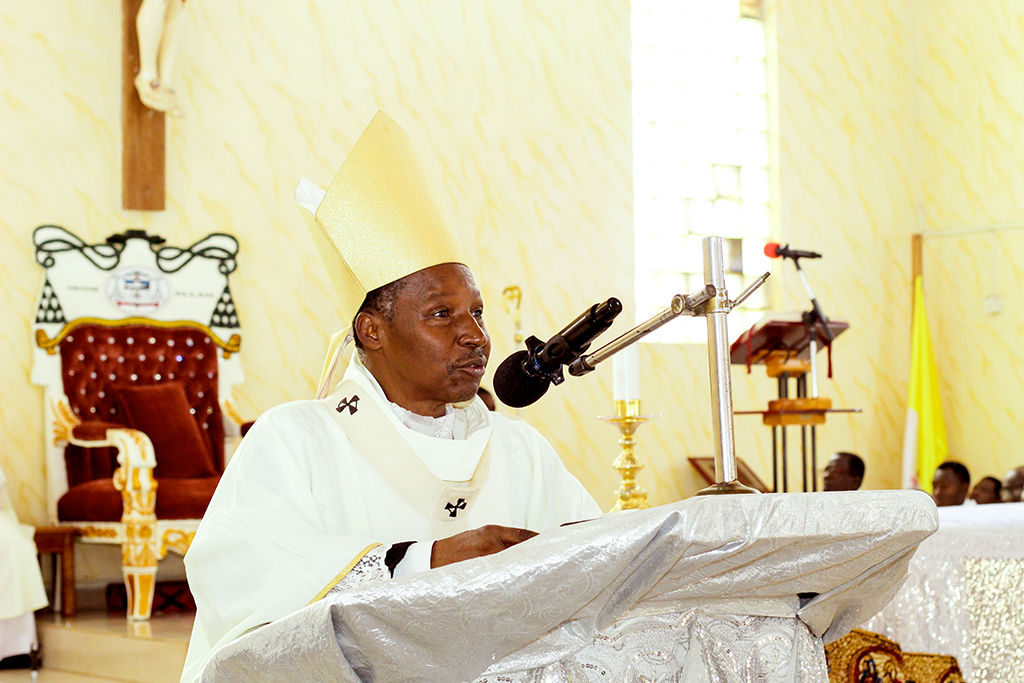
Archbishop Matthew Ishaya Audu of Jos Archdiocese has urged the Christian faithful to strengthen family bonds by overcoming obstacles that threaten harmony and unity in family life.
In his homily, on the Feast of the Holy Family, 29 December, Archbishop Audu called on Christian families to emulate the virtues of Jesus, Mary, and Joseph, describing the Holy Family as a timeless model of love, unity, and faith.
The Archbishop urged families to use the New Year as an opportunity to reevaluate their relationships, let go of past hurts, and rebuild harmony. “This is an auspicious time for families to evaluate their strengths, weaknesses, opportunities, and challenges,” he said. “It is a time to accept our mistakes, make amends, and work toward a better and more rewarding life in the family.”
Reflecting on the birth of Jesus Christ into a family, Archbishop Audu emphasized its divine importance as a “precious gift” bridging the Church and society. He underscored the role of the family as the cradle of civil society, stating, “It is within the circle of family life that the destiny of states is formed. Without family, all humanity is homeless.”
Quoting St. John Paul II’s Apostolic Exhortation Familiaris Consortio: he said “The family in the modern world, as much and perhaps more than any other institution, has been beset by the many profound and rapid changes that have affected society and culture.”
Highlighting the recent tragic events in Plateau State and other parts of Nigeria, Archbishop Matthew Ishaya Audu lamented the devastating impact of violence on families and communities. “Let us not forget in a hurry the families and communities in Plateau State that were attacked during the Christmas period,” he said. “Over 140 persons in 20 communities lost their lives in 2023. Additionally, 35 people died in a stampede in Ibadan, 20 in Okija, and 10 in Abuja—all for a portion of rice.”
The Archbishop expressed deep sympathy for the bereaved families and called for prayers for the injured, urging the government and other agencies to support internally displaced persons affected by these tragic events. “We commiserate with the bereaved families who lost their loved ones and pray for quick healing for those injured. I call on the government and other agencies to come to the aid of the internally displaced, victims of these merchants of death who are bent on sowing confusion,” he said.
He appeals “May God heal our pains, our hurts, and our wounds! May their deaths lead to the conversion of the unrepentant perpetrators of evil and their sponsors
Underscoring the family’s pivotal role in shaping individuals and society, Archbishop Audu described it as the first school, church, and social circle where love, care, and values are nurtured. “The family provides us with our sense of direction, our philosophy of life, and our spiritual and moral compass,” he explained.
He warned parents about the lasting impact of early childhood experiences on their children, noting that dysfunctional families often contribute to societal ills. “What a father says to a tiny child is held by posterity, and what a mother sings to a child in the womb could go all the way to the grave,” he said.
Archbishop Audu also reminded the faithful of their spiritual identity as members of God’s family. “Aside from the Holy Family of Jesus, Mary, and Joseph, there is the larger family of God, constituted by all who call God their Father,” he said. “When we celebrate the Feast of the Holy Family, we are also celebrating ourselves as God’s children.”
He emphasized the twofold responsibility of God’s children: to proclaim Jesus Christ as God and to love one another. Referencing 1 John 3:1, he added, “See what love the Father has given us, that we should be called children of God; and that is what we are.”
The Archbishop urged parents to balance their professional and family lives, warning of the consequences of neglecting familial responsibilities. “We have two lives to live: a private or family life and a public or professional one. These two should be in harmony, but very often they are in tension,” he said.
Citing a story about a boy offering to pay his father for an hour of his time, Archbishop Audu called for a reevaluation of priorities. He stressed, “The celebration of the Holy Family reminds and challenges us to value and invest in our private life with our families before our professional life, even when our job is as important as saving the world.”
In his concluding remarks, Archbishop Audu acknowledged that no family is perfect, but he encouraged families to emulate the Holy Family in times of challenges. “Though your family background may not be good enough, your background has no right to keep your back on the ground,” he said. He urged families to overcome misunderstandings and “bring light into their homes rather than the darkness of discord.”

 TWE Media Network
Leave a comment