
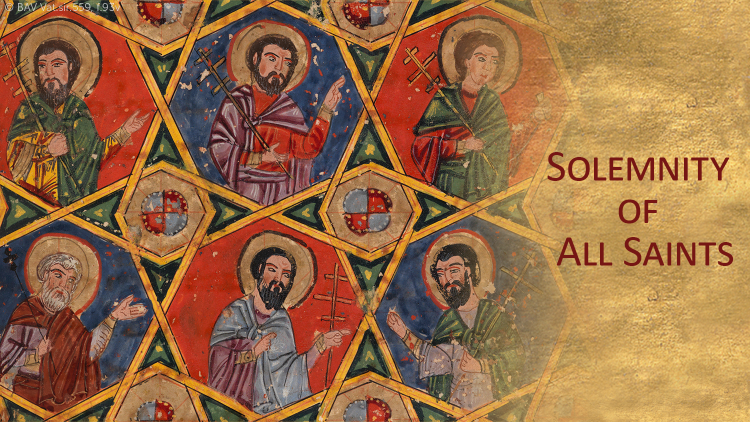
Photo Credit: Vatican News
By Chioma Polok
Saints are the holy men and women- true friends of God- to whom we should look up for they were fascinated by the promise of the Beatitudes as referenced in Matthew 5: 1-12. Their lives exemplified true sons and daughters of God; though not perfect, they found grace in God’s mercy and forgiveness.
By the end of the 2nd century, Saints were already being venerated. The holy martyrs and then the apostles, who were official witnesses of the faith were among the first to be venerated. Gradually, other men and women who lived heroic Christian lives became objects of veneration, especially after the great persecution under Imperial Rome. Martin of Tours became the first non-martyr to be venerated as a Saint. By the year 1000, ‘purchase’ of relics, a process for canonization was developed which required evidence of miracles.
According to Vatican News, it is noteworthy that the Solemnity of All Saints began in the East in the 4th century, and was observed on different dates elsewhere. England observed it on the 1st of November and this date was adopted in Rome in the early wake of the 9th century. This celebration falls toward the end of the liturgical year, a time when the Church contemplates the last things, remembering those who have crossed the gates of heaven and seeking to hold their memory in our hearts.
The Saints learned to know themselves, to know God, and to recognize their own weaknesses, trusting in the divine mercy of God.
Today, the Saints admonish us to aim for the goal and the prize that awaits us at the feet of Christ. They assure us there will be difficulties with each passing day, but we should know that after this life, our ultimate goal is eternal union with God.
This feast comes at the time where we reflect at the end of things-the end of the year- that the Saints are at our side, a model of a blessed life that intercedes for us and encourages us to live life with intense passion.
Today we are invited to rediscover the eight paths mapped out by Jesus in the Gospel: the Beatitudes. “Blessed are the poor in spirit for theirs is the kingdom of heaven…”. The emphasis is not on “Blessed”, as on the “For”. Someone is not “Blessed” because they are “poor”, but they are blessed because since they are poor, they are in a privileged condition of receiving the kingdom of heaven. The same will suffice for the other seven conditions.
“Blessed are they who mourn, for they will be comforted”; “Blessed are they who hunger and thirst for righteousness, for they will be satisfied”: “Blessed are the meek, for they will inherit the land”; “Blessed are the merciful, for they will be shown Mercy,” “Blessed are the clean of heart, for they shall see God”, “Blessed are the peacemakers, for they will be called children of God”, “Blessed are those who are persecuted for the sake of righteousness, for theirs is the Kingdom of heaven”, “Blessed are you when they insult you… Rejoice and be glad, for your reward will be great in heaven”. “For” explains everything that reveals where the meek will find trust, where peacemakers will find joy…”Blessed” is not a simple emotion but hope that spurs us to get back on our feet and not let any obstacles in life weigh us down. We are advised not to give up, but keep going because God is with us and in us.
Our goal is to see God and be at His side and become his prized possession now and today. We are enjoined to walk these eight paths so we can participate in the unending joy embedded in the book of Revelation. 1 John 3:1-3, “See what love the Father has bestowed on us that we may be called the children of God, yet so we are. We are God’s children now; What we shall be has not yet been revealed.”
Jesus extends the invitation to you and me in the words of the Beatitudes, if we are interested in making heaven. This call requires sacrifice, dying to self, and rejecting worldly temptations. In other instances, the world extends its own invitations to you contrary to Jesus’ Beatitude, offering you its own version of how to attain happiness through paths that lead to ruin. These are: we are all invited to feel happiness through an economical secure, comfortable life rather than one that is “poor in spirit”. It invites us to enjoy ourselves in any way and by any means possible, rather than saying, “blessed are those who mourn”. It invites us to prevail over others rather than be meek. It invites us to satisfy our hunger with everything, without ands, ifs and buts, rather than being satisfied with peace and justice. It advises us to think about ourselves, rather than being merciful. It invites us to go where our hearts takes us, satisfying every passion, rather than being pure of heart. It invites us to defend our turf rather than become peacemakers. It invites us to dominate and persecute rather than let ourselves be insulted!
The Beatitudes might seem counterintuitive, yet they are the eight paths for a beautiful, blessed, happy, fulfilled, successful, and holy life. It is not about words, it is not about ideas but the photograph of Jesus Himself: poor, meek, merciful, the one who surrenders… moved only by the desire “to be about his father’s business”- Luke 2: 41-50.
As mentioned, the emphasis is on “for” happiness derives from having a sense of one’s own life, of having a sense of one’s own direction, a reason for living that would even be worth dying for. ‘ Didn’t you know that I had be about my Father’s business?”, “…for theirs is the kingdom of heaven”. Joy, beatitude, therefore, do not come from external conditions, be it wellbeing, pleasure, success- experiences both fragile and passing- Matt. 7:24-28, but from the happiness promised by God to those who choose to behave in certain ways and manifest it in their daily lives.
Today’s solemnity shows that a “blessed “, “beautiful”, “successful”, “holy” life is possible for everyone. We can become “saints next door” of whom the Pope speaks about- People who are able to shine the light of God’s enduring love in every sphere of life.
We are encouraged to know that through our baptism we are already All Saints.

 TWE Media Network
Leave a comment