
By Chioma Polok
Saint Jerome, one of the most prominent figures in the early Christian Church, was born around 342–347 AD in Stridon, a town on the border of Dalmatia and Pannonia. Jerome’s influence within the Catholic tradition is profound, particularly due to his contributions to scriptural studies and his emphasis on the ascetic lifestyle. Recognized as a Doctor of the Church, Jerome’s writings hold great doctrinal importance.
Early Life and Conversion
Jerome was born into a wealthy Christian family, which provided him the means to receive an excellent education in grammar, rhetoric, and philosophy. He studied in Rome, where he became proficient in Latin and Greek and gained familiarity with classical literature. However, during his early years, Jerome led a somewhat dissolute life, indulging in secular pleasures. His path to conversion began during his studies, where he developed a deep interest in Christianity. He was baptized around 366 AD, which, at the time, was common practice for adult converts.
Following his conversion, Jerome dedicated his life to God. He traveled to Gaul, where he began his scholarly pursuits. Later, he journeyed to the East and embraced an ascetic lifestyle in the Syrian desert. During this period, Jerome studied Hebrew, a rare skill among Christian scholars, which would later play a crucial role in his scriptural work.
The Vulgate and Scriptural Scholarship
Saint Jerome’s most significant contribution to the Catholic Church was his translation of the Bible into Latin, known as the **Vulgate**. Around 382 AD, Pope Damasus I commissioned Jerome to revise the existing Latin translations of the Gospels. Eventually, Jerome undertook the ambitious task of translating the entire Bible. Notably, he used the original Hebrew texts for the Old Testament, rather than solely relying on the Greek Septuagint, a decision that highlighted his dedication to accuracy.
The Vulgate became the standard Bible of the Catholic Church for centuries, shaping Christian theology, liturgy, and art. Jerome’s translation made the scriptures more accessible to the Western Roman Empire, where Latin was the common language. His work also included extensive prefaces and commentaries, offering theological insights that underscored the importance of textual accuracy in biblical studies.
Writings and Theological Contributions
In addition to the Vulgate, Jerome was a prolific writer, producing numerous theological treatises, letters, and commentaries. His commentaries on the prophets and Pauline epistles are particularly notable, providing insight into the early Church’s scriptural interpretation. Jerome also wrote against various heresies of his time, including Arianism, Pelagianism, and Origenism, defending orthodox Catholic doctrine.
One of his most famous works is his collection of letters, which offer a unique view of the early Christian Church and his relationships with other significant figures. His correspondence with Saint Augustine reveals their theological debates, showcasing Jerome’s intellect and strong convictions. Despite their differences, Jerome respected Augustine’s scholarship, reflecting his willingness to engage in constructive discourse.
Asceticism and Spiritual Influence
Jerome was a staunch advocate of **asceticism**, believing that a life of simplicity, celibacy, and prayer was essential for spiritual growth. He spent much of his life in monastic communities, most notably in Bethlehem, where he founded a monastery around 386 AD. His teachings on asceticism deeply influenced many, inspiring others to adopt a similar lifestyle.
Jerome maintained close relationships with several Roman women from noble families, such as Saint Paula, who were moved by his ascetic teachings. Paula and her daughter, Eustochium, followed Jerome to the Holy Land and helped establish the monastic community in Bethlehem. Jerome’s ability to inspire others to renounce worldly wealth and embrace a life of poverty and devotion remains one of his most significant achievements.
Unique Qualities of Saint Jerome

Jerome was distinguished by his scholarly discipline and profound knowledge of languages. Few scholars of his time were as well-versed in Hebrew, Greek, and Latin, which allowed Jerome to approach the scriptures with unmatched depth and precision. His translations and commentaries demonstrated meticulous attention to detail, often cross-referencing texts to ensure their accuracy.
Known for his fierce temperament and combative nature, Jerome did not shy away from theological disputes. His sharp tongue is evident in many of his writings, where he criticized those he deemed heretical or misguided. While controversial at times, this quality demonstrated Jerome’s deep commitment to defending the faith.
Jerome’s **devotion to scriptural truth** set him apart. He believed that understanding the Bible required both rigorous study and humility. This conviction drove him to learn Hebrew later in life, a challenging task that few of his contemporaries would have attempted. His commitment to studying the Bible’s original languages set a precedent for future Christian scholars.
Jerome’s Followers and Influence
Saint Jerome’s influence extended far beyond his lifetime. His monastic community in Bethlehem became a model for later Christian monasticism, emphasizing both scholarship and ascetic practice. Jerome’s teachings on celibacy and asceticism helped shape the ideals of Western monasticism, later codified by Saint Benedict.
The Council of Trent (1545–1563) affirmed the Vulgate as the official Latin text of the Catholic Church, a testament to Jerome’s enduring influence. The Vulgate served as the basis for countless theological works, liturgical practices, and artistic representations of biblical scenes in the centuries that followed.
Jerome’s followers included not only his immediate circle, such as Paula and Eustochium, but also generations of scholars and monastics who looked to his writings for guidance. His influence on Church Fathers like Saint Augustine was significant, despite their occasional disagreements. Jerome’s legacy continues to inspire religious orders dedicated to asceticism and scholarship.
Veneration in the Catholic Church
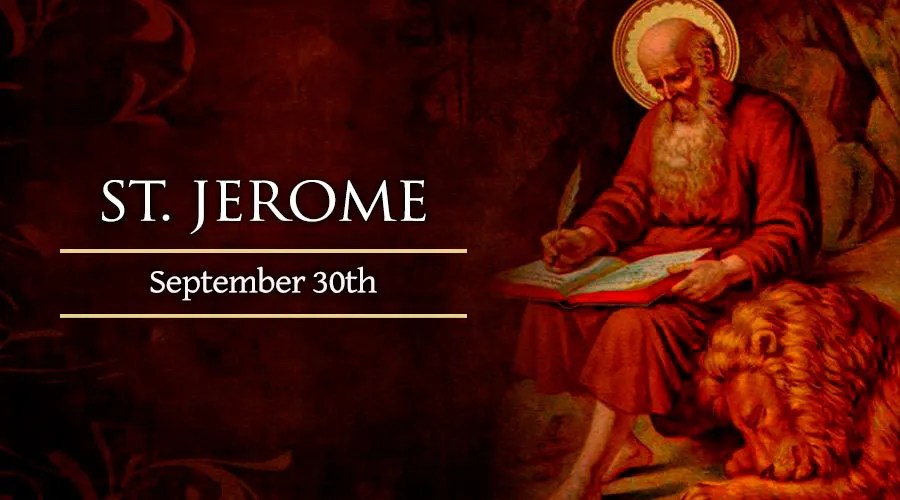
Saint Jerome is venerated as one of the **Doctors of the Church**, a title that reflects his immense contributions to Catholic theology and doctrine. His feast day is celebrated on September 30th, marking the day of his death in 420 AD. Jerome is often depicted in Christian art in a study surrounded by books and a skull, symbolizing his scholarly pursuits and contemplation of mortality.
Jerome is regarded as the patron saint of librarians, scholars, translators, and students, underscoring the Church’s recognition of his scholarly achievements. His dedication to scripture and his role in making the Bible accessible to the Western world exemplify the intellectual and spiritual pursuits valued by the Church.
Conclusion
Saint Jerome stands out in the history of the Catholic Church for his immense scholarly contributions, his devotion to asceticism, and his role in shaping Western Christianity. His translation of the Bible into Latin, known as the **Vulgate**, was a monumental achievement that influenced the Church for centuries. Jerome’s insistence on returning to the original languages of scripture, his prolific writings, and his dedication to asceticism marked him as a unique figure whose impact on Christianity endures to this day.
Though his life was marked by the tension between intellectualism and spirituality, Jerome’s fiery temperament and commitment to truth made him both admired and, at times, controversial. However, his lasting legacy as a Doctor of the Church and a guiding light for scholars and monastics alike is a testament to his enduring importance in the Catholic tradition.

 TWE Media Network
Leave a comment