
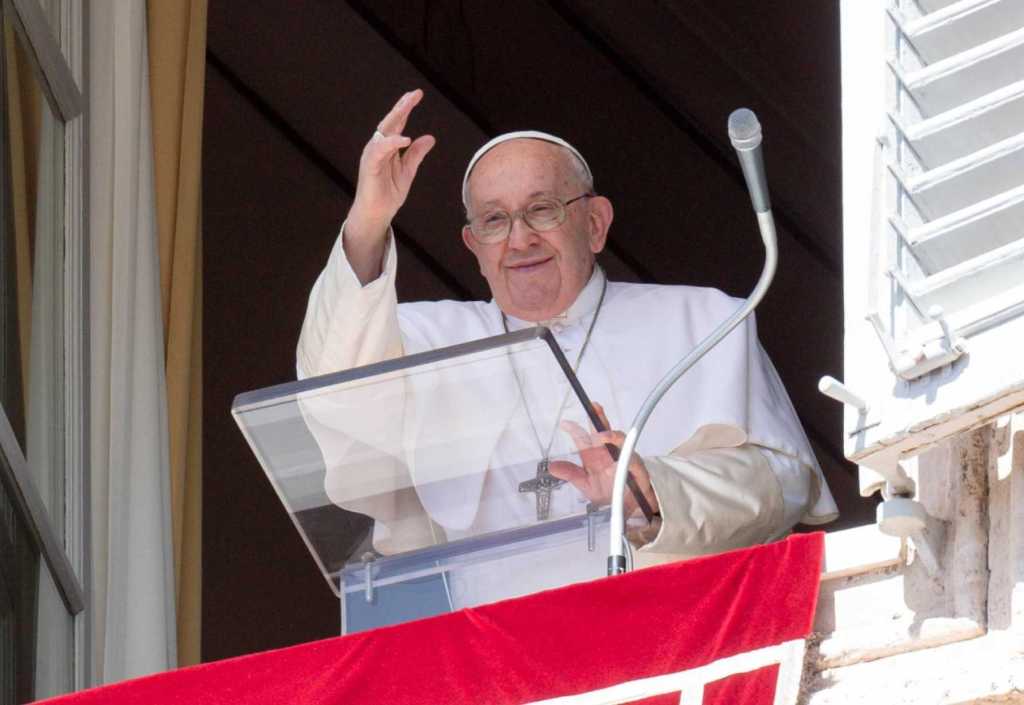
Pope Francis identifies the elements of offering, giving thanks and sharing as the summation of Jesus Christ’s celebration of the Last Supper, reflected in the miracle of the loaves and fishes.
The Holy Father in his reflection during the Angelus on Sunday, at the Vatican enumerated these three items which he mentioned is also contained in the Eucharistic celebration and further explaining, these are “the ways the Lord blesses us with His daily graces.”
Pope Francis urged the Christian faithful to “Savour” at all times God’s divine graces on humanity. Expatiating on the significance of the divine graces bestowed on the faithful by the miracle of multiplication as contained in the day’s Gospel, he explained that “offering” shows the charity that comes from the heart, with pure motive while the acceptance of the offering by “our yes” reveals a grateful heart that values such generous act.
“God makes it the material for the greatest miracle there is” he explained, when we receive Jesus Christ in Holy Communion during the Mass, the aspect of “offering” he emphasized showed God’s love and redemptive powers for humanity.
The Holy Father describing the act of “giving thanks” reminded the faithful that “we are to say to the Lord humbly and with joy that ‘All I have is Your gift, and to thank You I can only give back to you what You gave me first, together with your Son Jesus, adding what I can: ‘my feeble love.”’
In giving thanks to God for His goodness obtains for us His blessings “while He sanctifies, consecrates and multiplies ‘two copper coins’ of our fragile efforts.” Pope Francis said.
Finally, the Holy Father said the third element of the Eucharistic sacrifice consists in “sharing” during Mass, when we receive the Body and Blood of Jesus Christ, “that the fruit of everyone’s gift transformed by the Lord into food for all.”
The Pope remarked that it “is a beautiful moment,” that inculcates when “to live every gesture of love as a gift of grace, both for those who give and those who receive an occasion to grow together as brothers and sisters, ever more joined in charity.”
Reflecting on the significance of the gospel teachings, the tripartite gestures of divine grace contained in Holy Communion, he called on the faithful to examine themselves and establish their sincere attributes in the manner in which they offer, give thanks and share among their brethren the little in their possession as exemplified by Jesus Christ in the giving of Himself in the celebration of the Holy Eucharist.
“Do I truly believe that, by the grace of God, I have something unique to give to my brothers and sisters,” he asked, “or do I feel anonymously ‘one among many’?”
Furthermore, “Am I grateful to the Lord,” he continued, “for the gifts with which He continuously manifests His love?”
Finally, to ponder on, “do I live sharing with others as a moment of encounter and mutual enrichment?”
These Pope Francis said should serve as a guide. He called on the Blessed Mother to intercede for us to live every Eucharistic celebration with faith, being enlightened and, daily “savour” the “miracles” of God’s grace.

 TWE Media Network
Leave a comment