
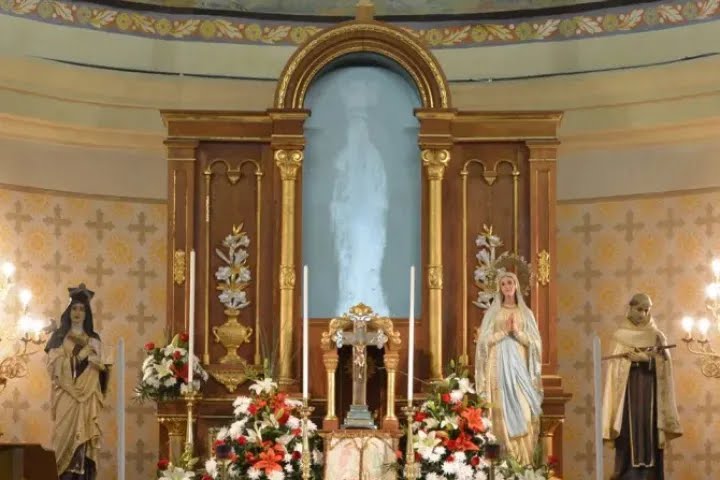
The Hospitality of Our Lady of Lourdes of Madrid, an archdiocesan pilgrim service organization recently completed its 101st pilgrimage, serving 800 participants. One of the pilgrims, a woman with severe visual impairment, reportedly regained her sight after performing the “water gesture” at the shrine. While this event is extraordinary, it must undergo a process of medical discernment before it can be officially a miracle.
The “water gesture” involves cupping water in one’s hands, washing one’s face three times, and then taking a sip, as St. Bernadette Soubirous did when directed by the Immaculate Conception at the Masabielle grotto.
The adviser to the archdiocesan association of faithful, Father Guillermo Cruz, wrote to the different groups that made up the pilgrimage, urging them to accept what happened with humility and simplicity, following the example of St. Bernadette.
“The experience of making a pilgrimage and discovering the love of God through our Mother, the Virgin Mary, as St. Bernadette teaches us in simplicity and humility, will always be the greatest grace that is granted at Lourdes, since it is the one that renews life,” he said.
Father Cruz further explained that “a pilgrim who suffers from several diseases and had very severe visual impairment, after making ‘the water gesture’ recovered her sight. This extraordinary event was immediately verified by the doctors, and the shrine was notified and has already recorded it.”
Cruz also explained the reason why it is not proper at this time to speak of a miracle, since this declaration requires “a process of medical and spiritual discernment that must be followed” in which “the following requirements regarding the healing must concur: Immediate. Complete. Lasting. Inexplicable.”
Accordingly, the adviser said: “We can’t get ahead of ourselves. A study has to be done and above all that the healing be maintained over time.” The priest stressed that “jumping ahead leads to presumption and we have to be humble. Here we have to wait for the study carried out by the Church at the Lourdes shrine, and then for the bishop of Madrid to make a pronouncement, to verify not only that it is inexplicable, but that it is also miraculous.”
The Lourdes Medical Bureau, has recognized 70 miracles to date, with most involving women. The bureau follows a rigorous process, including investigation and voting by the International Scientific Committee of Lourdes, before the bishop of the place where the cured person resides can declare a miracle.
The seven criteria doctors must take into account
The website of the shrine of Our Lady of Lourdes also specifies the seven criteria that must be observed during the medical investigation of cases. Before healing, the following must be taken into account:
1) The disease must be serious and have an unfavorable prognosis.
2) The disease must be known and cataloged by medicine.
3) The disease must “be organic, lesional,” and be examined by “objective, biological, radiological criteria.” This means that “even today, cures for pathologies will not be recognized without precise objective criteria, such as psychological, psychiatric, functional, and nervous diseases, etc.”
4) There should be no treatment to which the cure can be attributed.
5) The healing must be sudden, abrupt, instantaneous, immediate, and without convalescence.
After healing, two more criteria must be considered:
6) It should not be a simple regression of symptoms but rather a return to all vital functions.
7) It should not be a simple remission but rather a cure, that is, lasting and definitive.
Source: Catholic News Agency
Photo credit: Catholic News Agency

 TWE Media Network
Leave a comment