
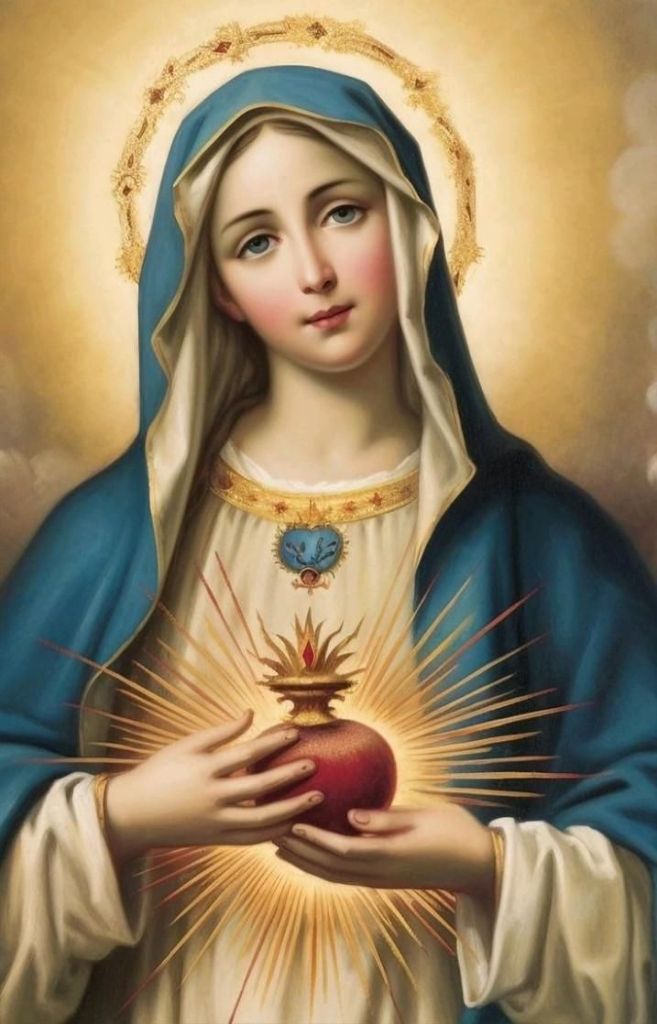
The theological roots of this title go back to the early Church. The Fathers of the Church, holy and studious bishops of the first centuries, often spoke of Mary as the New Eve. Just as the Woman Eve was “the mother of all the living” (Gen. 3:20), the Woman Mary was mother of all those living in Christ. In Revelation 12:17, St. John says that this Woman’s offspring are “those who keep the commandments of God and bear testimony to Jesus.”
In 2024, the memorial of Mary, Mother of the Church is celebrated on May 20. “[Mary] is mother wherever [Jesus] is Savior and head of the Mystical Body.” – The Catechism of the Catholic Church (paragraph 973)
Is the title “Mother of the Church” found in the Bible?
The title “Mother of the Church” is not found in Sacred Scripture, but Pope St. John Paul II covered several ways that the Bible alludes to this title:
Although the title “Mother of the Church” was only recently attributed to Mary, it expresses the Blessed Virgin’s maternal relationship with the Church as shown already in several New Testament texts.
Since the Annunciation, Mary was called, to give her consent to the coming of the messianic kingdom, which would take place with the formation of the Church.
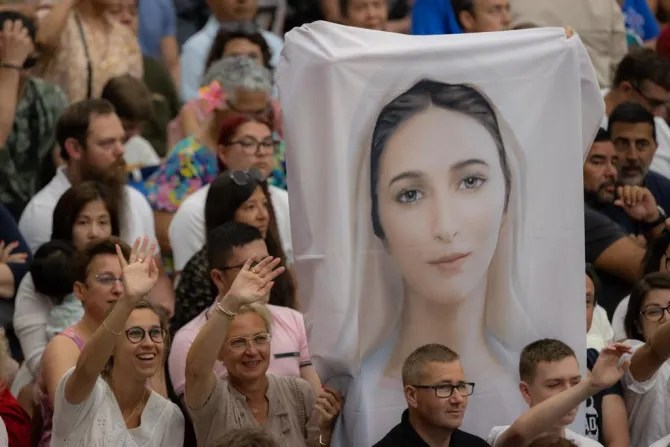
When at Cana Mary asked the Son to exercise his messianic power, she made a fundamental contribution to implanting the faith in the first community of disciples, and she co-operated in initiating God’s kingdom, which has its “seed” and “beginning” in the Church (cf. Lumen gentium, n. 5).
On Calvary, Mary united herself to the sacrifice of her Son and made her own maternal contribution to the work of salvation, which took the form of labour pains, the birth of the new humanity.
In addressing the words “Woman, behold your son” to Mary, the Crucified One proclaims her motherhood not only in relation to the Apostle John but also to every disciple. The Evangelist himself, by saying that Jesus had to die “to gather into one the children of God who are scattered abroad” (Jn 11:52), indicates the Church’s birth as the fruit of the redemptive sacrifice with which Mary is maternally associated.
The Evangelist St Luke mentions the presence of Jesus’ Mother in the first community of Jerusalem (Acts 1:14). In this way he stresses Mary’s maternal role in the newborn Church, comparing it to her role in the Redeemer’s birth. The maternal dimension thus becomes a fundamental element of Mary’s relationship with the new People of the redeemed. (General Audience, September 17, 1997)
How did Mary become the Mother of the Church?

The Father chose Mary from among all women to be the mother, according to human nature, of His Divine Son. As she is Mother of Christ in the natural order, she is also the Mother of His Mystical Body, the Church, of which He is the Head in the order of grace.
In the Book of Hebrews 2:9-13, the author makes it clear that Jesus is our brother:
[W]e see Jesus, who for a little while was made lower than the angels, crowned with glory and honor because of the suffering of death, so that by the grace of God he might taste death for every one.
For it was fitting that he, for whom and by whom all things exist, in bringing many sons to glory, should make the pioneer of their salvation perfect through suffering. For he who sanctifies and those who are sanctified have all one origin. That is why he is not ashamed to call them brethren, saying,
“I will proclaim thy name to my brethren, in the midst of the congregation I will praise thee.”
And again, “I will put my trust in him.”
And again, “Here am I, and the children God has given me.” (emphasis added)
Since Jesus is our brother, and Mary is His mother, it follows that Mary is our mother as well.
Finally, when Jesus was on the cross, we see the tender moment when He gave Mary to the Apostle John. In the Gospel of John 19:26-27, we read:
When Jesus saw his mother, and the disciple whom he loved standing near, he said to his mother, “Woman, behold, your son!” Then he said to the disciple, “Behold, your mother!” And from that hour the disciple took her to his own home.
Thus, the Tradition of the Church, coming from the Apostles, teaches us to understand that the Lord was entrusting all of His disciples to Mary, in the person of St. John.
“You are the mother of justification and of the justified, the Mother of reconciliation and of the reconciled, the mother of salvation and of the saved.” – St. Anselm
What is the role of the Virgin Mary in the Church?
The Catechism of the Catholic Church (paragraphs 964-965) teaches us,
Mary’s role in the Church is inseparable from her union with Christ and flows directly from it. “This union of the mother with the Son in the work of salvation is made manifest from the time of Christ’s virginal conception up to his death”; it is made manifest above all at the hour of his Passion:
Thus the Blessed Virgin advanced in her pilgrimage of faith, and faithfully persevered in her union with her Son unto the cross. There she stood, in keeping with the divine plan, enduring with her only begotten Son the intensity of his suffering, joining herself with his sacrifice in her mother’s heart, and lovingly consenting to the immolation of this victim, born of her: to be given, by the same Christ Jesus dying on the cross, as a mother to his disciple, with these words: “Woman, behold your son.”
After her Son’s Ascension, Mary “aided the beginnings of the Church by her prayers.” In her association with the apostles and several women, “we also see Mary by her prayers imploring the gift of the Spirit, who had already overshadowed her in the Annunciation.”
Also, Pope St. Paul VI, in “Credo of the People of God,” said the following:
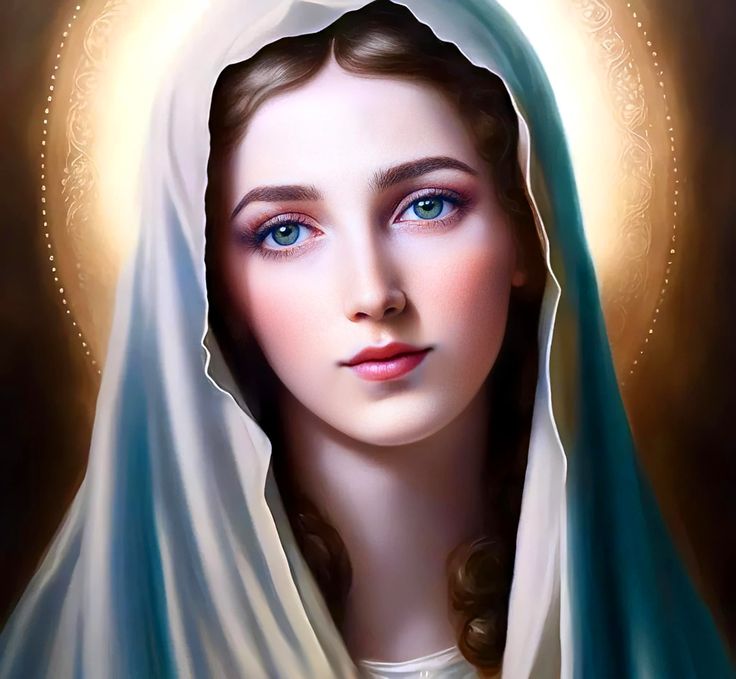
Joined by a close and indissoluble bond to the Mysteries of the Incarnation and Redemption, the Blessed Virgin, the Immaculate, was at the end of her earthly life raised body and soul to heavenly glory and likened to her risen Son in anticipation of the future lot of all the just; and we believe that the Blessed Mother of God, the New Eve, Mother of the Church, continues in heaven her maternal role with regard to Christ’s members, cooperating with the birth and growth of divine life in the souls of the redeemed.
“We believe that the Holy Mother of God, the new Eve, Mother of the Church, continues in heaven to exercise her maternal role on behalf of the members of Christ.” – Pope St. Paul VI
Why is the Church herself called Mother?
At a General Audience in 2013, Pope Francis explored the meaning of the Church being our “Mother.”
Among the images that the Second Vatican Council chose to help us understand the nature of the Church better, there is that of “mother”: the Church is our mother in faith, in supernatural life (cf. Dogmatic Constitution Lumen Gentium, nn. 6,14,15,41,42). It is one of the images most used by the Fathers of the Church in the first centuries and I think it could be useful for us too. For me it is one of the most beautiful images of the Church: Mother Church! In what sense and in what way is the Church mother? We start with the human reality of motherhood: what makes a mother?
First of all a mother generates life, she carries her child in her womb for 9 months and then delivers him to life, giving birth to him. The Church is like this: she bears us in the faith, through the work of the Holy Spirit who makes her fertile, like the Virgin Mary. The Church and the Virgin Mary are mothers, both of them; what is said of the Church can be said also of Our Lady and what is said of Our Lady can also be said of the Church! …
A mother does not stop at just giving life; with great care she helps her children grow, gives them milk, feeds them, teaches them the way of life, accompanies them always with her care, with her affection, with her love, even when they are grown up. And in this she also knows to correct them, to forgive them and understand them. She knows how to be close to them in sickness and in suffering. In a word, a good mother helps her children to come of themselves, and not to remain comfortably under her motherly wings, like a brood of chicks under the wings of the broody hen. The Church like a good mother does the same thing: she accompanies our development by transmitting to us the Word of God, which is a light that directs the path of Christian life; she administers the Sacraments. She nourishes us with the Eucharist, she brings us the forgiveness of God through the Sacrament of Penance, she helps us in moments of sickness with the Anointing of the sick. The Church accompanies us throughout our entire life of faith, throughout the whole of our Christian life. …
A third brief thought. In the first centuries of the Church, one thing was very clear: the Church, while being the mother of Christians, while “making” Christians, is also “made” by them. The Church is not distinct from us, but should be seen as the totality of believers, as the “we” of Christians: I, you, we all are part of the Church. St Jerome wrote: “The Church of Christ is nothing other than the souls of those who believe in Christ” (Tract. Ps 86: PL 26,1084). Thus the motherhood of the Church is lived by us all, pastors and faithful.

 TWE Media Network
Leave a comment