
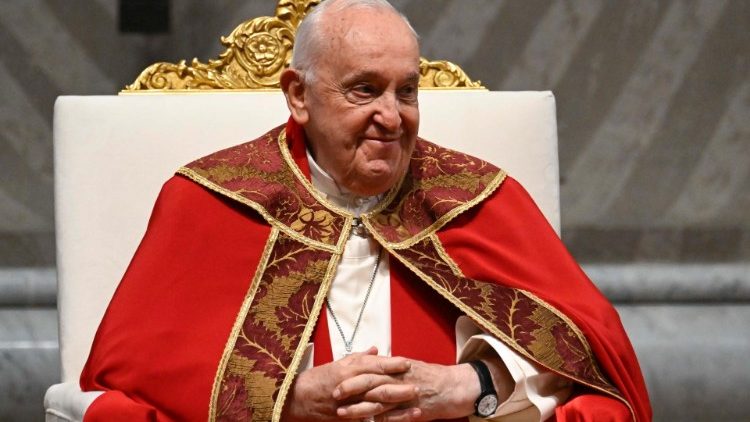
On the feast of Pentecost, Pope Francis calls on Christians to spread the Gospel to everyone with gentleness and the power of the Holy Spirit.
During His homily at St. Peter’s Basilica, the pope said that the Holy Spirit’s “work in us is powerful, as symbolized by the signs of wind and fire,” adding that it is also gentle and “welcoming to all.”
“From the ‘upper room’ of this basilica, like the apostles, we too are being sent forth to proclaim the Gospel to all,” Pope Francis stated in his homily on May 19.
“Thanks to the Spirit, we can and must do this with his own power and gentleness,” he asserted.
Pope Francis emphasized that this power is not arrogant, calculating, or imposing but is “born of fidelity to the truth that the Spirit teaches us in our hearts.”
“Consequently, we do not give up but tirelessly proclaim peace to those who desire war, forgiveness to those who seek revenge, welcome and solidarity to those who bar their doors and erect barriers, life to those who choose death, respect to those who love to humiliate, insult, and reject, fidelity to those who would severe every bond, thereby confusing freedom with a bleak and empty individualism,” he added.
“Nor are we intimidated by hardship, derision, or opposition, which, today as always, are never lacking in the apostolate.”
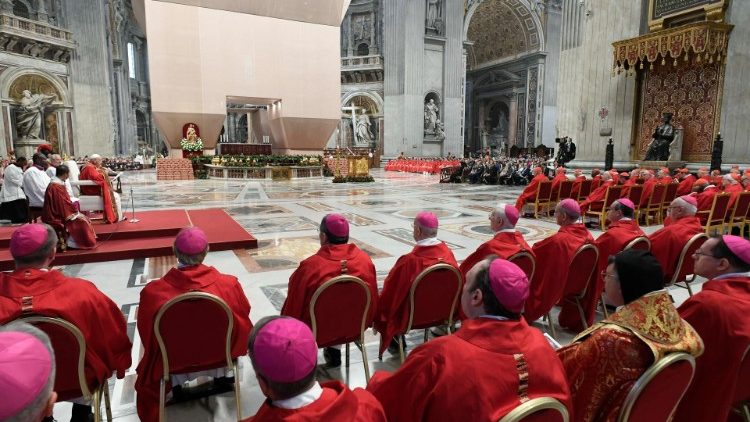
Pope Francis celebrated the Mass the day after his scheduled visit to the northern Italian city of Verona. The holy Father who is 87-year-old was not the main celebrant but shared an abbreviated version of the homily from the front of the worshippers to the right of the alter.
The Prefect of the Dicastery for Divine Worship and Discipline of the Sacraments, Cardinal Artur Roche, was the main celebrant who presided over the Pentecost Mass.
While explaining the Gospel, Pope Francis described how the Holy Spirit assists us to overcome sinful passions, like impurity, and then gently plants seeds of virtue and helps them to develop.
“He lovingly protects these virtues, so that they can grow stronger and so that, after the toil of combatting evil, we may taste the wetness of mercy and communion with God,” he said.
“As a beautiful prayer of the early Church says: ‘Let your gentleness, O Lord, and the fruits of your love abide with me,’” he added.
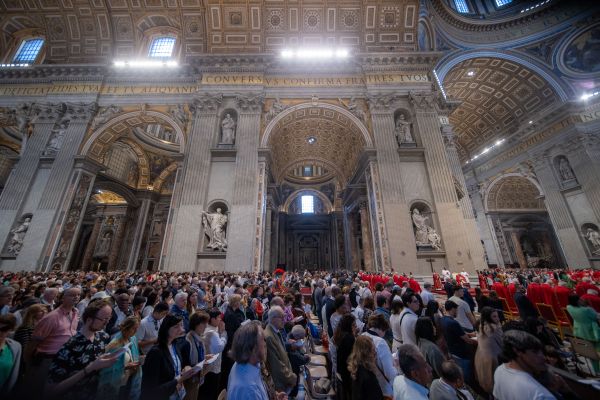
Furthermore, when the Mass ended, Pope Francis appeared in the window of the Apostolic Palace, where thousands were gathered inside St. Peter’s Basilica and prayed the “Regina Caeli” in Latin.
Listening to the word of God helps to “silence the chatter” and makes way for one to hear the soothing voice of the Holy Spirit, the Pope said to the Christian faithful that converged on St. Peter’s Square.
The Holy Spirit instills in us “transformative words of love,” he added, that help us to realize the eternal love of God. The pope recommended that people spend time praying in silence in Eucharistic adoration to hear the voice of the Holy Spirit.
Pope Francis also prayed for the Holy Spirit to bring communion between Christians, harmony in families, and an end to wars in Ukrain and the Holy Land.
The Solemnity of the Pentecost, which is celebrated 50 days after Easter, marks the descent of the Holy Spirit.
At the end of his Pentecost homily, Pope Francis prayed: “Come, Creator Spirit, enlighten our minds, fill our hearts with your grace, guide our steps, grant your peace to our world.”

 TWE Media Network
Leave a comment