
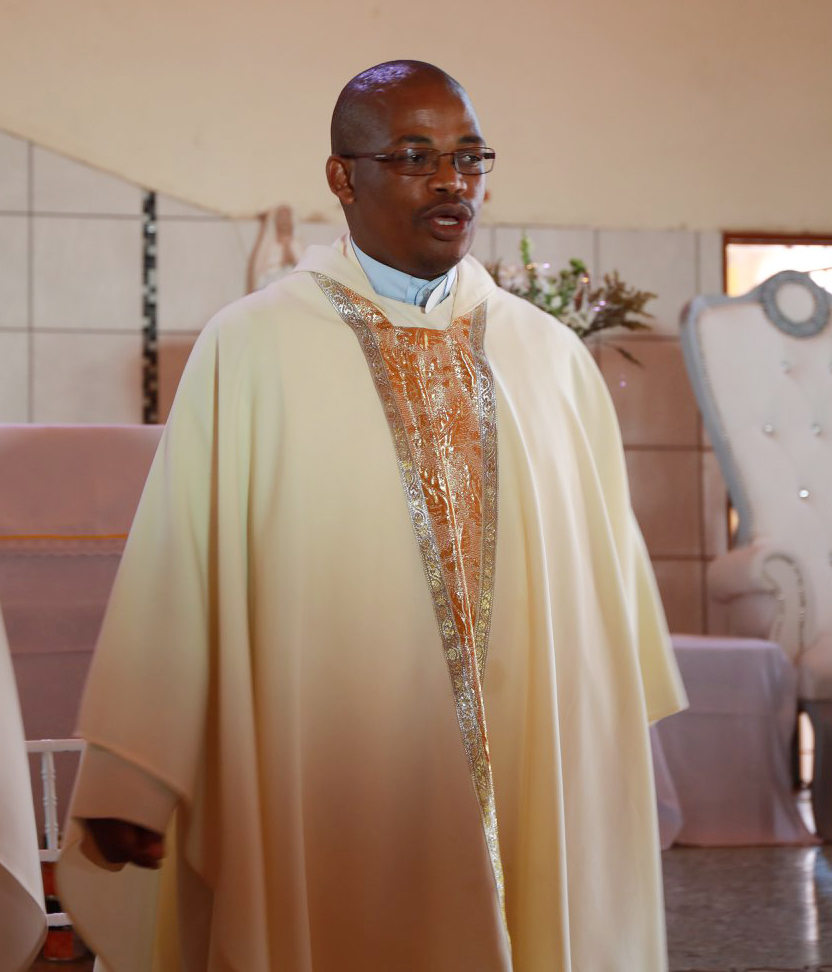
Fr. Paul TatuMothobi, a member the Congregation of the Sacred Stigmata (CSS/ Stigmatines) and former Media and Communications Officer of the Southern African Catholic Bishops’ Conference (SACBC), is the latest victim of murder in South Africa.
The native of Lesotho’s Catholic Archdiocese of Maseru, who was enrolled at the University of Johannesburg for a doctorate in communication, sponsored by the government of Lesotho, “passed on to be with the Lord on Saturday, 27th April 2024 after sustaining a gunshot”, the “Death Notice” by the South Africa-based CSS Provincial Secretary, Fr. Jeremia Thami Mkhwanazi, reads in part.
According to reports, Fr. Tatu’s lifeless body with gunshot wounds was found on April 27 in his car on N1 Road, a national road in South Africa, running from Cape Town through Bloemfontein, Johannesburg, Pretoria and Polokwane to Beit Bridge, a border town with Zimbabwe.
In a Monday, April 29 statement, SACBC members condole with the Stigmatines and Fr. Tatu’s family, and describe his killing as “not an isolated incident”, recalling the March 13 murder of Fr. William Banda, the Zambian-born member of St. Patrick’s Missionary Society (Kiltegan Fathers), who was shot in the sacristy of the Holy Trinity Cathedral of South Africa’s Tzaneen Diocese.
“Fr. Tatu worked for several years as the SACBC media and communications officer with dedication; we are saddened by his tragic death. We extend our condolences to the Stigmatine congregation, to which he belonged and to his family,” Catholic Bishops in Botswana, Eswatini, and South Africa say in the one-page statement that their President, Bishop SithembeleSipuka, signed.
The Catholic Church leaders add, “It must be noted that the death of Fr. Paul Tatu is not an isolated incident but rather a distressing example of the deteriorating state of security and morality in South Africa.”
The murder of Fr. Tatu and that of Fr. Banda, SACBC members lament, “occurs amid growing concerns about the increasing disregard for the value of life, where people are wantonly killed.” Born on 31 December 1978 in Teyateyaneng (T.Y), a town in Lesotho’s district of Berea, the late Fr. Tatu joined the Stigmatines in 1998. He studied philosophy at St. Francis House of Studies in Pretoria from 1999 to 2000 and moved on to Botswana for Novitiate.
Before theological studies, the late Catholic Priest took a year off from Priestly formation, during which he lived with miners in South Africa’s Free State; he accompanied miners in mining theory, setting theory, and English among other lessons.
He later resumed Priestly formation, joining Pretoria-based St. John Vianney Seminary, under the Stigmatines, for theology. He was ordained a Priest in 2008.
The Stigmatines later commissioned Fr. Tatu to Tanzania as a missionary. While in the East African nation, he pursued media and communication studies at Mwanza-based St. Augustine University of Tanzania (SAUT) of the Tanzania Episcopal Conference (TEC).
He was one of ACI Africa’s collaborators. Lately, Fr. Tatu facilitated the writing of April 9 story that featured Pontsho Florina Tumisi’s praiseworthy initiative to address addiction of youths to drugs.
In a Tuesday, April 30 Facebook post, Enency Kuki has eulogized Fr. Tatu as “a great shepherd”, saying, “As we journey with Christ and always ask our Saviour to Protect us the devilish acts also uses the slightest second to throw out what we have treasured. We’re hurting; we wish there could be justice to such. We lost a great Shepherd. Condolence to his fellow priests in his order, family and friends. Padre may your soul rest in peace.”
In the April 29 statement, SACBC President underscores the need for authorities in South Africa to protect human life.
“On behalf of the Bishops, I appeal to all people responsible for these murders to refrain from thinking that they can do what they like with people’s lives. Life belongs to God, and no one has a right to take it as one pleases,” Bishop Sipuka says.
He decries lawlessness in South Africa, and addressing himself to President Cyril Ramaphosa-led government says, “Mr President and Police minister, there is a growing impression among South Africans that criminals are freely murdering the citizens with no fear of consequences.”
“A deliberate termination of the life of one person affects not only the person killed but a whole network of relationships of that person,” SACBC members say.
They explain, “A family person killed affects the family of that person, the extended family, friends, colleagues, and those dependent on the dead person for support. Killing one person brings about pain and misery to many people.”
“While making this call for the respect of life, we know that some people have taken a position not to respect life and will continue to kill, and for this reason, we have a government with a mandate to deal with such people,” SACBC members further say.
They emphasize the need for governments in their region to put in place “immediate and effective measures to ensure the security of law-abiding citizens who work hard to support their families and for our Catholic priests who spend their lives serving the people of this country.”
“We appeal to you to make the well-being and safety of our people a top priority. As a church, we are at your disposal for discussion and strategies to stop the murder of innocent people, which is now becoming a pandemic in this country,” Catholic Bishops in Botswana, Eswatini, and South Africa say in their April 29 statement following the murder of Fr. Tatu.

 TWE Media Network
Leave a comment