
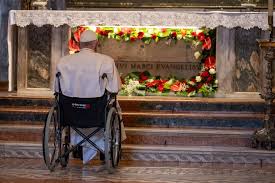
Pope Francis has urged Christians to encounter Jesus Christ through the communion of unity and fraternity, during his Sunday homily at Mass in St. Mark’ Square, Venice, Italy.
With over 10,000 pilgrims in attendance, the Holy Father charged Christians that in being conscious of “Remaining united to Christ, we can bring the fruits of the Gospel into the reality we inhabit.”
“Faith in Jesus, the bond with him, does not imprison our freedom. On the contrary, it opens us to receive the sap of God’s love, which multiplies our joy, takes care of us like a skilled vintner, and brings forth shoots even when the soil of our life becomes arid,” the Pope said.
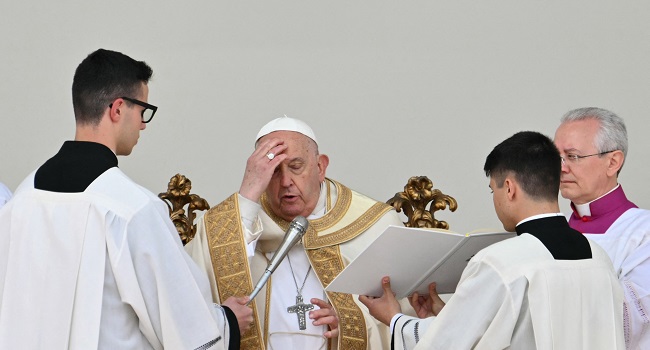
Furthermore, the Pope reiterated that the benefits of togetherness also embody “ Fruits of justice and peace, fruits of solidarity and mutual care, carefully- made choices to preserve our environmental and human heritage.”
Pope Francis who arrived in Venice on Sunday, April 28, for a trip to the prestigious Biennale art exhibition; for the 60th anniversary, also elicits excitement for being the first Pope to visit the Biennale – where the Vatican has held a pavilion since 2013; with the theme “With My Eyes”, coincides with the theme of the anniversary “Foreigners Everywhere.”
In his teaching of the gospel reading, the Holy Father remarked that Christian worship with Christ should be one that invigorates and propels one to be active in the body of Christ in order to “grow in relationship with him, to converse with him, to embrace his word, to follow on the path of the kingdom of God.”

The Pope drew more attention to the need for “ Christian communities, neighbours, and cities to become welcoming, inclusive, and hospitable places,” highlighting the warmth and friendship which represents the image of the City of Venice as a place of encounter and cultural exchange.”
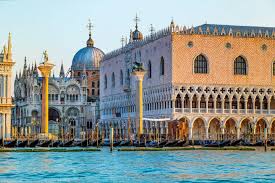
Pope Francis remarked that Venice “is called to be a sign of beauty available to all, starting with the last, a sign of fraternity and care for our common home,” he further cited the fragile state of Venice, saying that despite its fame and beauty, as a UNESCO World Heritage Site, it is saddled with a lot of challenges stemming from excessive tourism to environmental challenges such as rising sea levels and erosion.
After the recitation of the Regina Caeli, the Pope went into St. Mark’s Basillica to venerate the relics of the evangelist before leaving by helicopter to return to the Vatican, as worshippers and tourists bid him farewell from land and sea.
As part of his schedule, the Holy Father also met with female inmates, staff, and volunteers at Venice’s Women’s Prison on the Island of Giudecca, where he spoke on the topic of human dignity, suggesting that prison can “mark the beginning of something new, through the rediscovery of the unsuspected beauty in us and in others.”
The deeply symbolic visit was followed by a brief encounter with the artists responsible for the Holy See’s pavilion at the Biennale, where the pope encouraged the artists to use their craft “ to ride the world of the senseless and by now empty oppositions that seek to gain ground in racism, in xenophobia, in inequality, in ecological imbalance and aporophobia, that terrible neologism that means ‘fear of the poor.”’
The Holy Father travelled by a private vaporetto, or waterbus, bearing the two-tone flag of Vatican City, to the 16th-century baroque Basilica of Santa Maria della Salute, which sits on the Punta della Dogana, where he met with a large group of young people.
Reflecting on the visit as a “beautiful moment of encounter,” the pope encouraged the youth to “rise from sadness and lift our gaze upward.”
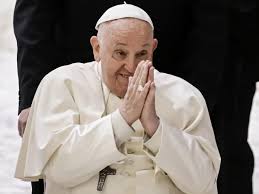
“Rise to stand in front of life, not to sit on the couch. Arise to say, ‘Here I am!’ to the Lord, who believes in us.” Building on this message of hope, which the pope emphasized is built upon perseverance, telling them “don’t isolate yourself” but seek others, experience God together, find a group to walk with so you don’t grow tired.”
The pope made his way to St. Mark’s Square in a white open-top golf cart bearing the papal seal, where he closed his visit with Mass. At the end of the Mass Archbishop Francesco Moeaglia, the patriarch of Venice, thanked the pope for his visit.
“Venice is a stupendous, fragile, unique city and has always been a bridge between East and West, a crossroads of peoples, cultures, and different faiths,” Moraglia noted.
“For this reason, in Venice, the great themes of your encyclicals – Fratelli Tutti and Laudato Si – are promptly reflected in respect and care for creation and the person, starting with the good summit of life that must always be respected and loved, especially when it is fragile and asks to be welcomed.”

 TWE Media Network
Leave a comment